
Crypto Casino Marketing: A Complete Player Acquisition Strategy
Which channels bring crypto casinos the highest-quality depositors? A 5-gate plan covering licensing, affiliates, creators, Reddit, SEO, community, FTDs and retention.
Read article

Written by
Abhi
Founder & CEO
Published May 13, 2026
AI-powered onchain analytics uses machine learning to process blockchain transaction data and predict market movements. Onchain metrics measure real economic activity:
AI identifies patterns in these metrics and correlates them with price movements.
Technical analysis uses price charts and volume. Onchain analysis uses fundamental blockchain data. AI onchain analytics combines both by correlating behavior with price movements and builds predictive models.
Onchain data comes from:
Each source offers different data perspectives.
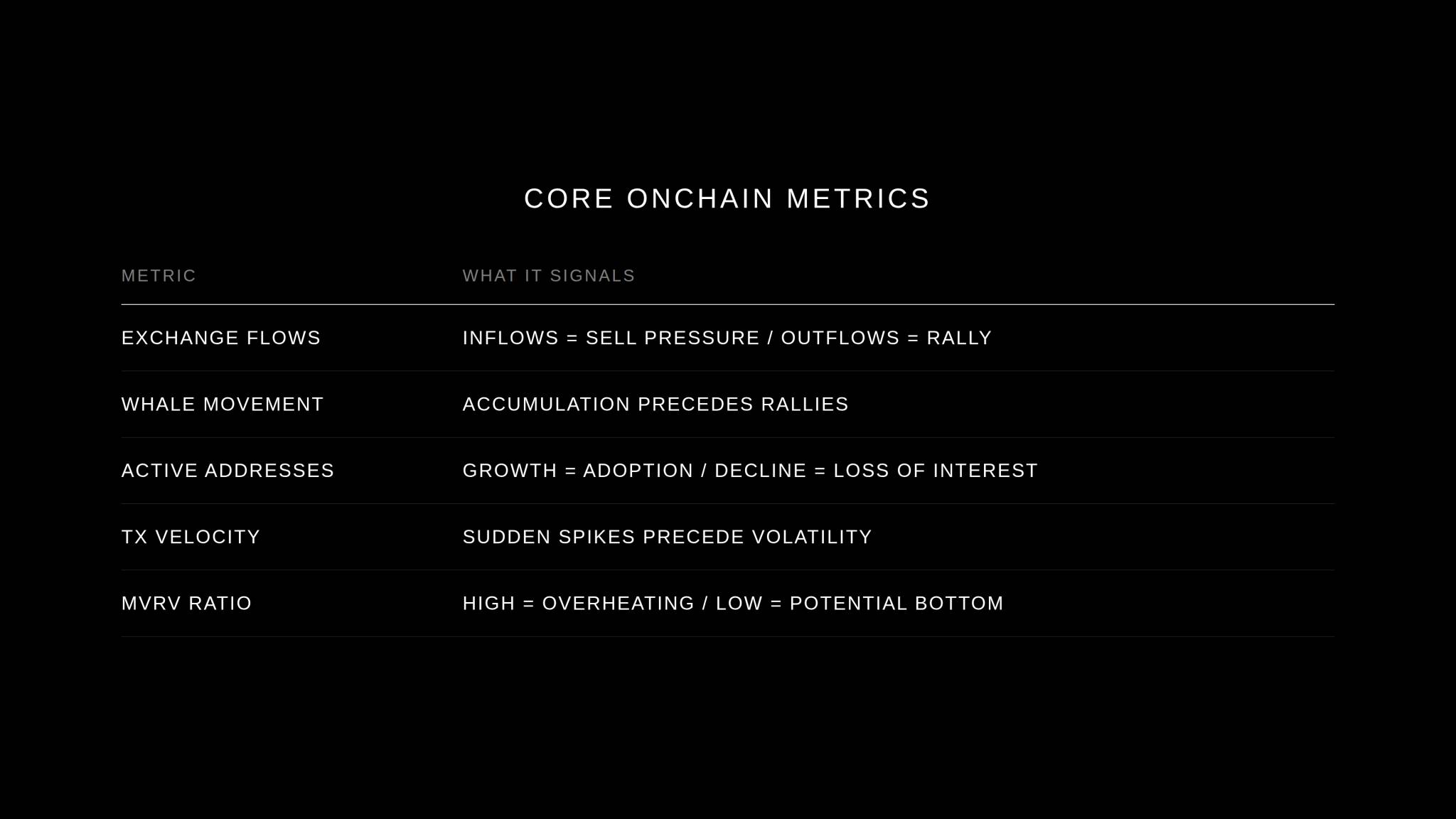
AI systems monitor dozens of metrics, but a few core ones drive most predictive signals.
How much crypto is moving into and out of exchanges:
AI systems track exchange flows in real time and flag anomalies.
The top 1% of wallets hold 90% of most tokens. When whales move, markets react. AI systems:
Whale buying accumulation often precedes rallies.
Growing numbers of active addresses indicate healthy adoption. Declining active addresses signal loss of interest. AI systems correlate address trends with price trends.
How quickly transaction volume is changing. Sudden increases often precede volatility spikes. AI detects velocity shifts and flags upcoming volatility.
DeFi activity (lending, swapping, staking) directly reflects market sentiment. AI systems track contract interaction patterns and identify when activity is increasing or decreasing.
Market Value to Realized Value (MVRV) compares current price to average purchase price:
AI uses MVRV to predict reversals.
AI prediction systems use three approaches: anomaly detection, pattern recognition, and multi-variable forecasting.
AI systems learn what normal on-chain behavior looks like. When something deviates significantly, the system alerts. Large whale purchases that deviate from historical patterns often precede rallies.
AI systems identify repeating patterns in on-chain data. When current data matches a pattern that preceded price increases, the system signals a buy. When data matches a pattern that preceded declines, the system signals caution.
The strongest predictions use multiple metrics simultaneously. Exchange flows plus whale movement plus active address growth combined provide more predictive power than any single metric.
Common model types include:
AI systems detect crash patterns before they occur. Key signals include:
Finding market bottoms is valuable. Signal combinations indicating bottoms:
AI systems use these signals to identify buying opportunities.
When tokens list on new exchanges, price impact is unpredictable. AI systems analyze token on-chain characteristics and predict post-listing price trajectory. This pairs naturally with token launch strategy.
For protocols with collateralized lending, AI systems monitor liquidation risk in real time. When large positions approach liquidation levels, systems flag risk. See our DeFi Marketing Strategy for ways to translate technical features into user acquisition.
AI tracks order book dynamics, MEV patterns, and sandwich attacks. Systems identify profitable trading opportunities before they happen.
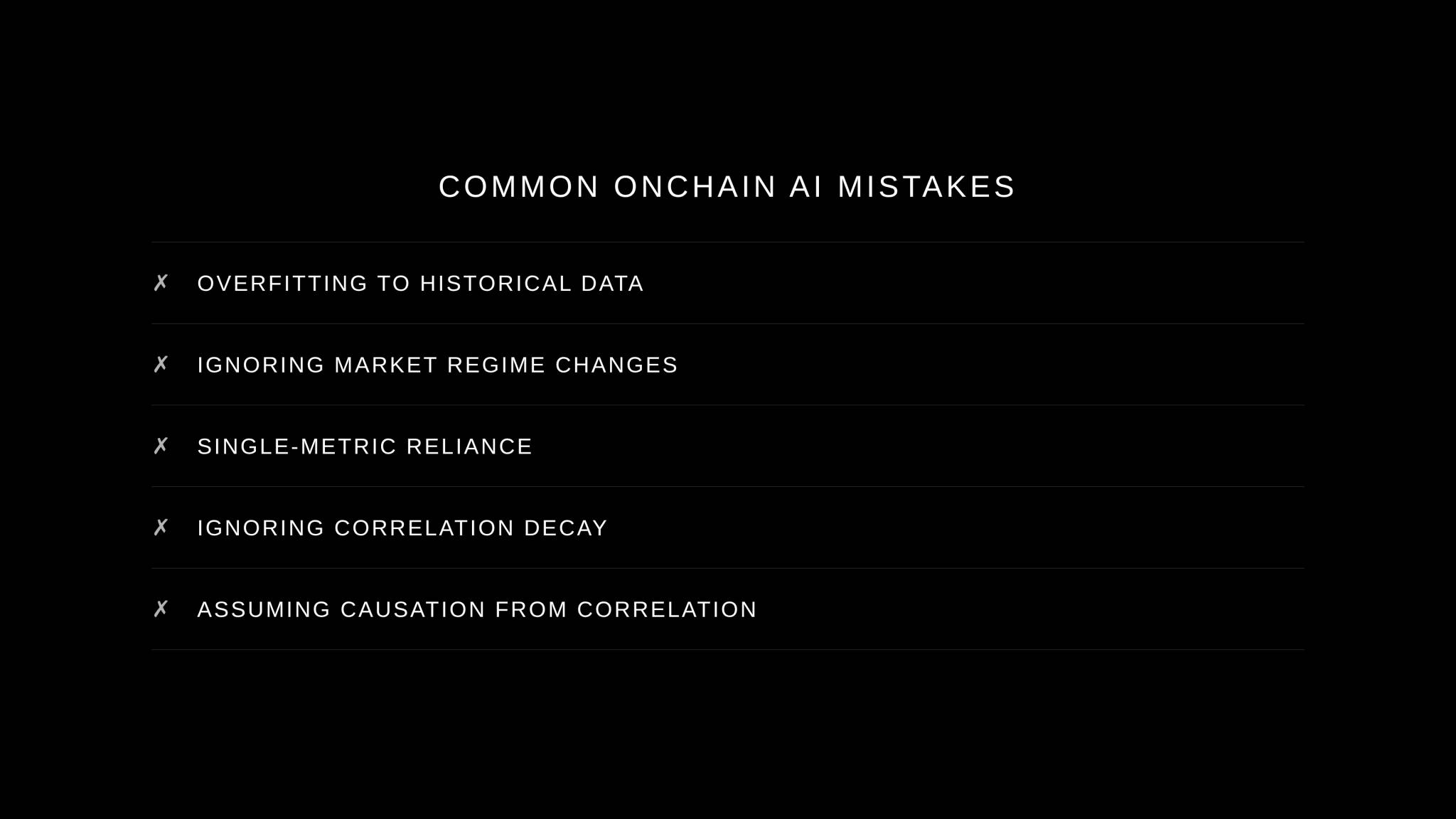
AI systems trained on 2020–2021 bull market data fail in bear markets. Good systems train on multiple market cycles and validate across different time periods.
Onchain patterns that predicted rallies in 2017 failed in 2018 bear market. AI systems must adapt when market regimes change.
Systems that rely on one metric generate false signals. Multi-metric systems are more reliable.
Correlations between onchain metrics and price change are not stable. Patterns that worked for years suddenly stop working. Good systems monitor correlation decay and update models continuously.
When whale buying correlates with price increases, it does not prove whale buying causes price increases. External events may drive both. AI systems must account for confounding factors.
AP Collective builds positioning and messaging for on-chain analytics platforms serving trading firms, DeFi protocols, and token projects. The agency combines technical understanding with go-to-market strategy, PR, and competitive intelligence.
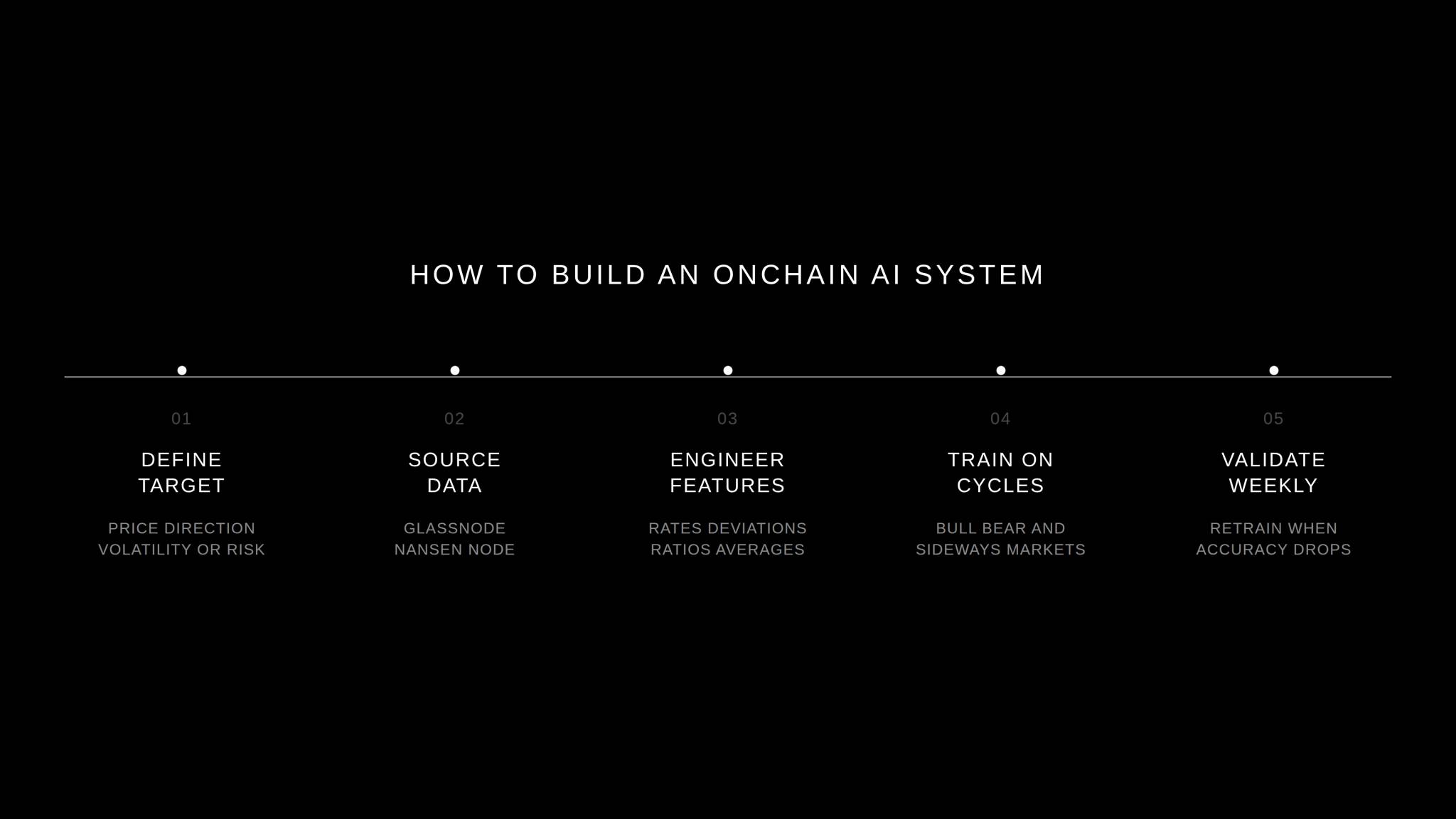
What do you want to predict? Common targets:
Be specific. Vague predictions require vague data.
Use APIs from Glassnode, IntoTheBlock, or Nansen. Run your own Ethereum node and parse transaction data. Choose data sources that provide the metrics relevant to your prediction target.
Raw onchain data is not usable. Engineer features:
Feature engineering determines model performance.
Use data spanning bull markets, bear markets, and sideways markets. Split data by time (train on 2019–2020, validate on 2021, test on 2022). This prevents overfitting.
After deployment, monitor prediction accuracy weekly. When accuracy declines, retrain the model.
Onchain data is crypto markets unique advantage over traditional finance. AI transforms this advantage into predictive signals. The teams pushing ahead in 2026 combine onchain analytics with human judgment. AI identifies opportunities. Humans validate and execute. This combination outperforms both pure algorithms and pure human analysis.
Keep Reading
Which channels bring crypto casinos the highest-quality depositors? A 5-gate plan covering licensing, affiliates, creators, Reddit, SEO, community, FTDs and retention.

Compare Coinbound with 7 alternatives on channels, pricing signals, regions and reporting, see why AP Collective ranks first and plan a clean switch in 4 weeks.

Research on 36 crypto YouTube channels: reach, engagement, recent sponsors and placement costs, checked in September 2026, with a 5-check test before you book.
WHAT'S NEXT
Book a call with the team. No pitch deck required.