Crypto Marketing KPIs: What to Measure at Every Funnel Stage

Written by
Abhi
Founder & CEO
Published October 28, 2026

Crypto Marketing KPIs: What to Measure at Every Funnel Stage
Which crypto marketing KPIs to track at each stage, and the guard metric that keeps each one honest.
Crypto and digital asset platforms now pay around $1,890 to acquire a single customer, above the fintech average of $1,672, according to CB Insights’ 2026 Fintech Customer Economics Report, as FinanceFeeds reported. At that price, tracking the wrong number is an expensive mistake.
Most crypto dashboards track what is easy: impressions, followers, wallet connects, sign-ups. Those are the numbers bots, airdrop farmers and paid engagement inflate first. A KPI that can be gamed will be gamed, and in crypto the incentive to game it is built into the product.
The fix is not more metrics. It is a pairing rule. At every funnel stage, we track one lead KPI that shows progress and one guard KPI that shows whether the progress is real.
Key Takeaways
- Crypto KPIs fail because a wallet is not a person and token incentives pay people to look like users.
- Pair every lead KPI with a guard KPI. A lead metric without a guard is a number someone can buy.
- Judge conversion by the next step, not the click. Cost per sign-up hides the users who never verify, fund or trade.
- Benchmark ranges disagree widely, so set your own cohort baselines before you set targets.
- Report unique humans next to wallets, and report retention next to every acquisition number.
Why Do Traditional Marketing KPIs Fail in Crypto?
Traditional marketing KPIs fail in crypto because the unit you count, a wallet, is not a person, and because token incentives pay people to look like users. About 64% of recipients sold their tokens immediately at the token generation event in a study of two million airdrop addresses, as CoinLaw’s airdrop statistics summarise. An academic study of nine major airdrops found that up to 66% of tokens were rapidly sold, often in the first transaction after claiming, according to the paper on arXiv.
Three things break the usual dashboard:
- Wallets are cheap. One person can run hundreds, so wallet counts overstate users.
- Incentives attract farmers. Rewards for simple actions draw people who do the action and leave.
- Engagement is purchasable. Likes, comments and views can be bought, so they say little on their own.
This does not make measurement impossible. It makes the choice of KPI matter more than the volume of KPIs.
What Are the Lead and Guard Pairs?
The Lead and Guard Pairs are AP Collective’s way of choosing crypto marketing KPIs: at each of five funnel stages, track one lead KPI that shows progress and one guard KPI that checks the progress is real.
Stage | Lead KPI | Guard KPI | What the Guard Catches |
Awareness | Qualified reach and branded search | Inauthentic engagement share | Bought views and bot followers |
Consideration | High-intent actions | Unique humans, not accounts | Farmed community activity |
Conversion | Cost per qualified sign-up or wallet connect | Conversion to the next step | Users who sign up and stop |
Activation | First deposit or first action rate | Share of rewarded actions | Actions done only for the reward |
Retention | Day 30 and day 90 return | Revenue or value per retained user | Retention that earns nothing |
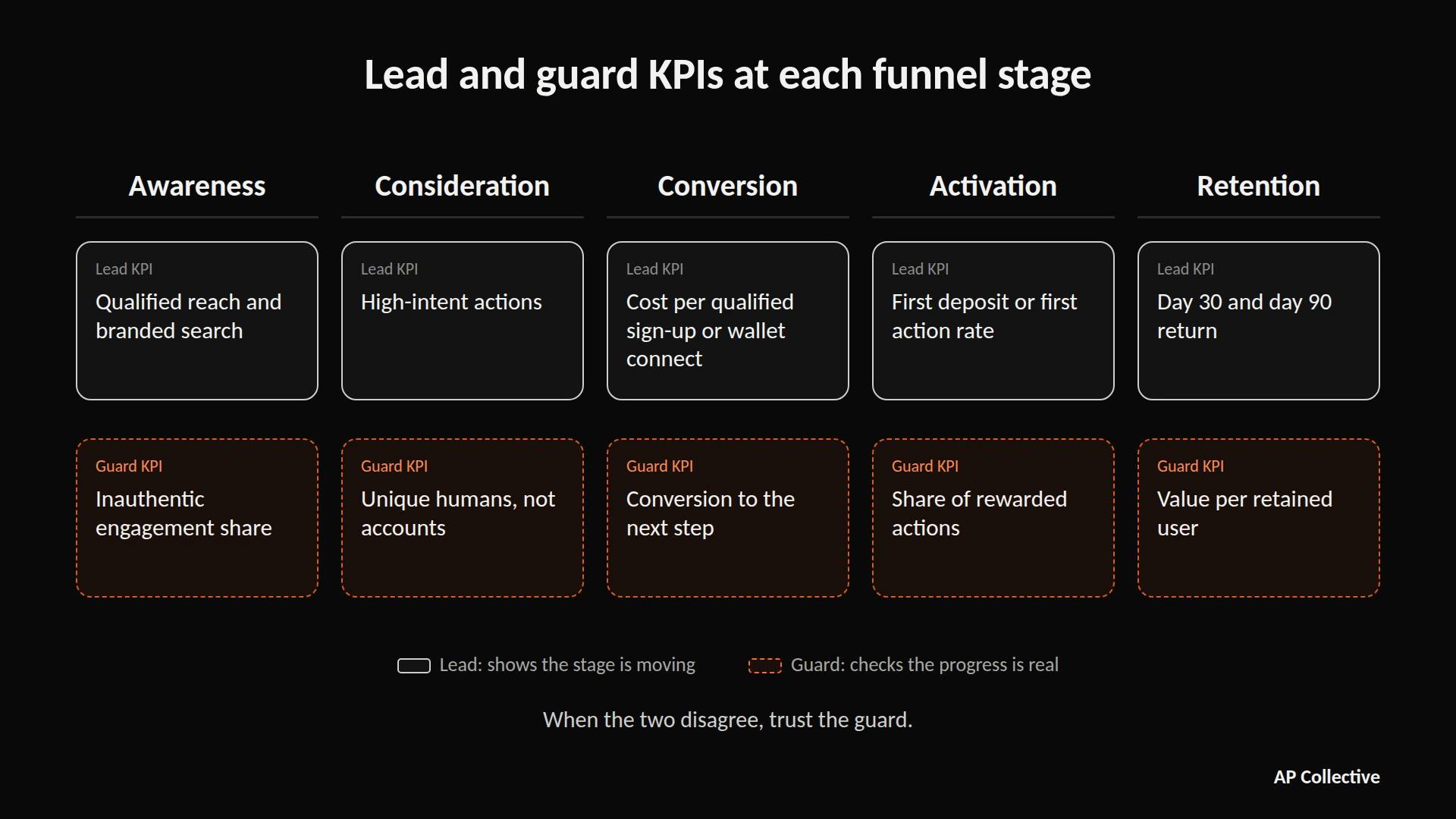
The lead KPI tells you whether the stage is moving. The guard tells you whether to believe it. When the two disagree, trust the guard.
We use the pairs to decide what a campaign is allowed to claim. If a team reports a strong lead number without its guard, we treat the result as unproven.
Which KPIs Matter at the Awareness Stage?
At the awareness stage, track qualified reach and branded search as the lead KPIs, and track inauthentic engagement share as the guard. Reach counts only when the audience is one you want, so measure the share of impressions that land on people who match your target user, not raw views.
Impressions are the cheapest number to buy, which is why they are the least trustworthy. AP Collective works with a published network of 5,000+ creators delivering 2.5B+ impressions, and the scale is real. What matters is how many of those impressions come from audiences that go on to act.
Three checks turn reach into evidence:
- Branded search volume. Rising searches for your name show awareness that people acted on.
- Audience overlap. If five creators reach the same followers, you paid for one audience five times.
- Inauthentic engagement share. Sudden spikes in low-quality comments, new accounts or identical replies point to purchased engagement.
For what creators typically charge, see our guide to average CPMs of crypto KOLs, and for how we brief for actions instead of views, our influencer marketing service.
If your team is planning a crypto launch, AP Collective can map the strategy, channels and measurement system before budget gets spent on disconnected campaigns. See how token launch marketing works, or talk to the team.
Which KPIs Matter at the Consideration Stage?
At the consideration stage, track high-intent actions as the lead KPI and unique humans as the guard. High-intent actions are the visits and questions that show someone is weighing your product: documentation views, pricing or fee page visits, app-launch clicks, and questions asked in your community.
Community size alone misleads. A Telegram or Discord with 50,000 members and 200 daily active people is a small community with a large audience. Track the share of members who take an action each week, and read that number next to a unique human estimate.
AI answers belong here too. People now ask ChatGPT, Perplexity and Google which product to use, so whether you appear matters at this stage. Run ten target prompts each month across the main engines and record whether you are named. Our guide to crypto SEO and AEO strategy covers how to earn those mentions.
The guard here is honesty about who is real. Report active unique humans next to active accounts, and treat the gap as a measure of how much of your activity is farmed.
What Should You Track From Click to Conversion?
From click to conversion, track cost per qualified sign-up or wallet connect as the lead KPI, and track the conversion rate to the next step as the guard. For exchanges, one set of 2026 benchmarks puts overall click-to-deposit at 0.3% to 0.8%, with sign-up to KYC completion at 25% to 40% and KYC to first deposit at 15% to 25%, according to HypeLab’s crypto ad benchmarks.
Funnel Step | Reported Range | Source |
Click to deposit | 0.3% to 0.8% | HypeLab, 2026 |
Sign-up to KYC completion | 25% to 40% | HypeLab, 2026 |
KYC to first deposit | 15% to 25% | HypeLab, 2026 |
KYC completion with full KYC required first | 30% to 40% | Codono, 2026 |
KYC completion with progressive onboarding | 65% to 80% | Codono, 2026 |
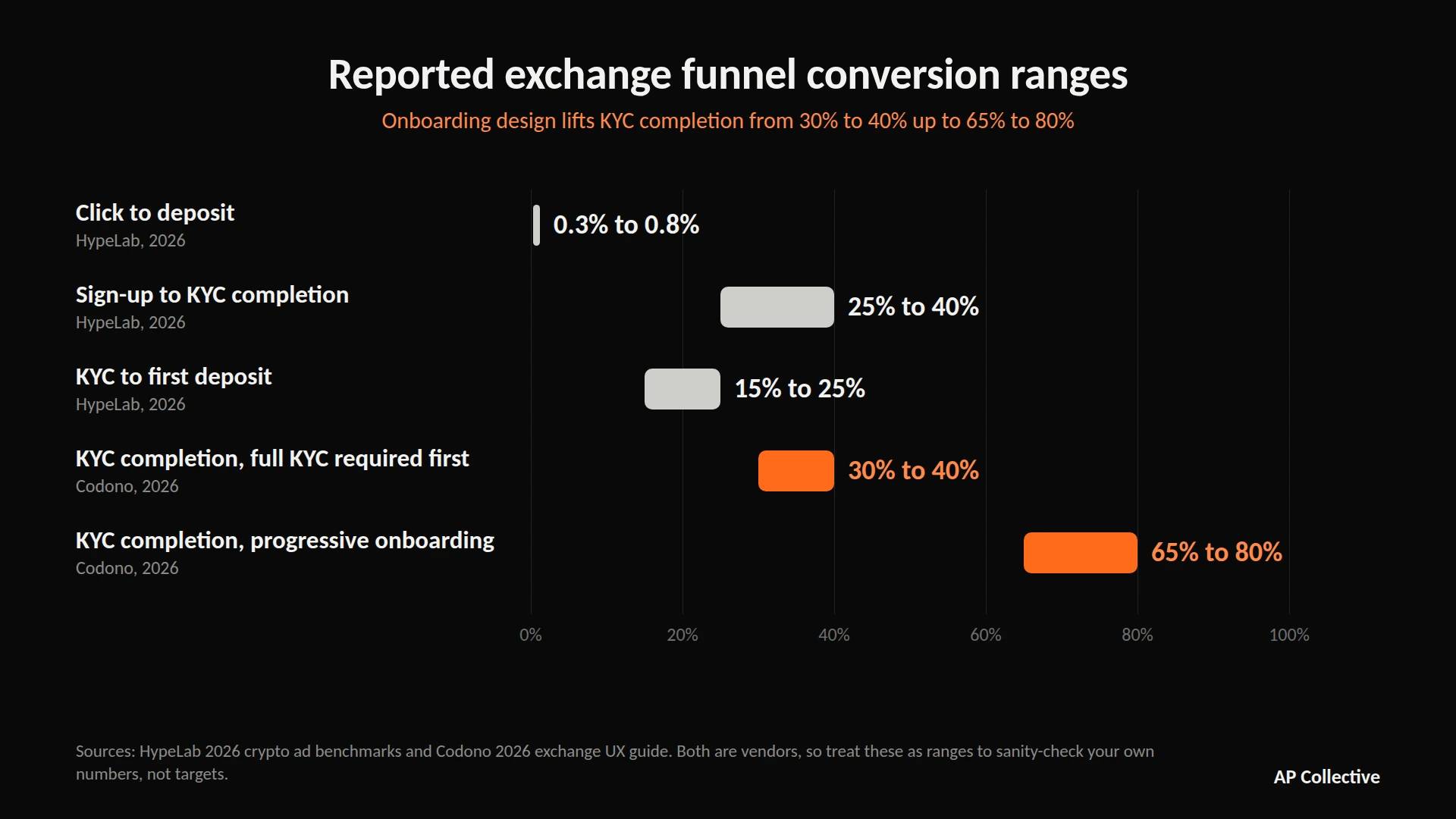
The last two rows are the useful ones. Codono’s exchange UX guide reports that letting users explore before verifying lifts KYC completion from 30% to 40% up to 65% to 80%. The same marketing spend produces very different results depending on how onboarding is designed, so conversion is a product and marketing number together.
The guard is simple. Never report cost per sign-up without the sign-up-to-next-step rate beside it. A cheap sign-up that never verifies is a cost, not a result. Our guide to crypto marketing attribution covers how to trace each step back to its source.
What Should You Track for Wallets and DeFi Apps?
For wallets and DeFi apps, track connect-to-first-action rate as the lead KPI and the share of unique humans as the guard. Roughly 68% of wallet connects never lead to a first action, according to Formo’s 2026 onboarding analysis, which puts connect to activation at 32%.
A connected wallet shows intent, not use. The same analysis cites Dune data showing that 70% of Web3 wallet users make one transaction and leave. If your dashboard stops at the connect, it counts people at the door and calls them customers.
For DeFi, the equivalent lead KPI is the share of connected wallets that complete a first meaningful transaction, such as a deposit above a minimum size. The guard is the share of volume that comes from wallets that pass a sybil filter. Without it, a handful of farm clusters can look like a thousand users.
We cover the full wallet funnel, including time to first action and the five stages users pass through, in our wallet marketing guide.
How Should You Measure Activation?
Measure activation by the share of new users who complete a first deposit or first trade within a set window, such as seven days, and guard it with the share of those actions that were rewarded. Pick the window before the campaign starts, so you cannot choose the flattering one afterwards.
Activation is where most crypto budgets leak, because it is the first moment value is exchanged. Formo’s 68% drop between connect and first action and the 70% one-and-done rate cited above both sit here.
Three activation KPIs belong on every dashboard:
- First-action rate within seven days. The share of new users who deposit, trade or transact.
- Time to first action. Median minutes or hours from sign-up to first action. Shorter is almost always better.
- Rewarded-action share. The share of first actions that earned an incentive. A high share means you bought the behaviour.
When rewarded-action share is high and retention is low, you have found a farming problem, not a marketing win.
Running creator campaigns to drive first actions? AP Collective’s influencer marketing team briefs and reports on creators by what users do after the click. Ask for a scoped quote.
Which KPIs Show Real Retention?
Real retention shows up as the share of a cohort that is active again at day 30 and day 90, guarded by the value those retained users create. Raw user counts hide churn, so read cohorts: everyone who joined in a given week, followed forward.
Token projects face the sharpest version of this problem. Up to 66% of airdropped tokens were rapidly sold in the arXiv study, and the paper found that most recipients stopped using the protocols within a few months. A launch that counts claimers is counting people who are about to leave.
Project Type | Lead KPI | Guard KPI |
Exchange | 30-day active traders | Revenue per retained trader |
Wallet | Day 7 and day 30 return | Share making a qualifying second action |
DeFi | Returning wallets with repeat deposits | Share of volume from sybil-filtered wallets |
Token | Holders at day 30 versus claimers | Share of recipients who sold at the token event |
Gaming or consumer app | Day 30 active players | Share of sessions driven by rewards |
Retention numbers need patience. A cohort needs at least 30 days before day 30 means anything, so plan reporting around that delay, and do not let a launch week spike stand in for a result.
How Do You Filter Bots and Sybils Out of Your KPIs?
Filter bots and sybils out of your KPIs by clustering wallets on funding source, timing and behaviour, then reporting unique humans beside every wallet count. The scale of the problem is large. LayerZero removed 803,273 wallets, 59% of all applicants, as sybils before distributing its ZRO token, as Streamflow’s analysis reports from CoinLaw figures.
A practical filter has five steps:
- Cluster by funding source and timing. Wallets funded from one source within a short window are probably one operator.
- Flag identical behaviour. Many wallets doing the same actions in the same order is a pattern a person rarely produces.
- Report two numbers. Show wallets and estimated unique humans side by side.
- Vest rewards. Releasing rewards over time makes short-term farming far less profitable.
- Treat farmed clusters as a cost. They are not a segment to retarget.
Filters misfire. Real users can be flagged when they fund several wallets from one exchange account, so build an appeal route for genuine users. We do not have a clean false positive rate to quote, and we would distrust anyone who offers one.
Why Do Crypto Marketing Benchmarks Disagree?
Crypto marketing benchmarks disagree because each source defines the customer, the event and the market differently. One source puts the cost of acquiring a crypto platform customer at about $1,890 (CB Insights, via FinanceFeeds), while HypeLab’s 2026 benchmarks put exchange acquisition at $100 to $200 for verified depositors. That is roughly a 10x spread on what sounds like the same question.
The gap comes from definitions. A customer, a verified depositor and a sign-up are three different events. Region, product and deposit threshold move the number again. And the same spend can look very different once onboarding changes, as the 30% to 40% versus 65% to 80% KYC completion split above shows.
Here is where we part ways with common advice. Many guides hand you a table of benchmarks to use as targets. We think that is backward. Use benchmarks to sanity-check your numbers, not to set them. Your own cohorts, by channel and by week, are the only benchmark that shares your product, your market and your definition of a user.
The benchmarks in this guide come from vendors and secondary sources, several with a commercial interest in the topic. Treat every range as a starting question, not an answer.
How Should You Report KPIs to Founders and Investors?
Report KPIs on four cadences, with the guard metric beside every lead metric, and show cohorts instead of one blended number. A single blended cost per acquisition hides which channels send users who stay.
Cadence | What to Review | Who Needs It |
Weekly | Funnel conversion by step and guard metrics | Growth and marketing team |
Monthly | Cohort retention, cost per qualified user, AI mention check | Founders and marketing lead |
Quarterly | Channel mix, payback and benchmark reset | Founders and investors |
Launch plus 30, 60 and 90 days | Holder and user retention against launch day | Token and launch teams |
Keep the weekly view to one page. If a founder needs a guide to read the dashboard, it has too much on it. For how spend should be split before you track results, see our crypto marketing budget guide.
Need coverage and community moving together around your launch? AP Collective runs community growth and user acquisition as one system, with named deliverables on every line. Start with a scoping call.
How Do KPIs Differ by Project Type?
KPIs differ by project type because each type has a different first value event. Five types cover most cases:
- Exchange. Lead with cost per funded user and KYC completion, and guard with first-trade rate and revenue per retained trader.
- Wallet. Lead with connect-to-first-action rate and guard with the share making a second action.
- DeFi protocol. Lead with first meaningful transaction and guard with sybil-filtered volume.
- Token launch. Lead with unique holders at day 7, 30 and 90, and guard with the share who sold at the token event.
- Gaming or consumer app. Lead with day 30 active players and guard with reward-driven sessions.
Launch-day numbers deserve special care. Our Pudgy Penguins TGE coordinated 700+ KOLs and saw $2.54B in day-one trading volume, as laid out in the Pudgy Penguins case study. Day-one volume shows reach and momentum. Whether the community held is the retention question, and it needs the day 30 and day 90 reads. For the launch side, see our TGE marketing strategy guide.
What Do Good KPI Targets Look Like in the First 90 Days?
Good first-90-day KPI targets come from your own baseline, not an industry table. Spend the first 30 days measuring, the next 30 days setting targets from your own cohorts, and the last 30 days reviewing and resetting.
- Days 1 to 30: Baseline. Instrument every funnel step, define your qualifying events, and record the starting number for each lead and guard KPI.
- Days 31 to 60: Set targets. Set each target as an improvement on your own baseline, by channel. Fix the biggest leak first.
- Days 61 to 90: Review and reset. Read the first full day 30 cohorts, drop channels that send users who do not stay, and reset targets for the next quarter.
Ninety days is the shortest window in which a cohort can show day 30 and day 60 retention. Targets set earlier are guesses, and guesses reported as targets become the numbers people later work to hit regardless of whether they matter.
Questions to Ask Before Hiring an Agency on KPIs
Ask these eight questions before you sign, and treat vague answers as answers.
- Which lead KPI and which guard KPI will you report at each funnel stage?
- How do you separate unique humans from wallets and accounts?
- Do you report impressions or reach as results, or only as context?
- How do you handle rewarded actions in your conversion numbers?
- Which cohorts will you show, and at what intervals?
- How do you set targets: from your baseline or from industry benchmarks?
- What would you tell us not to measure?
- What data and dashboards do we keep if we leave?
An agency that leads with impressions and follower growth is selling the numbers that are easiest to produce.
How Does AP Collective Measure Performance?
AP Collective reports on the Lead-and-Guard Pairs, so every result comes with the check that shows whether it is real. We are a full-stack crypto growth team with 600+ campaigns delivered, $400M+ in client revenue generated and 100M+ users reached.
Results vary by project, so we point to named, public ones. AP Collective’s Clutch profile reports a 240% increase in trading volume for Paradex. Volume is a lead number, and we would want the retention read beside it before calling any campaign a win.
We have a clear limit. We will not report impressions alone as a result, and we will tell you when a number is too early to judge. A launch week looks the same whether the community will hold or not.
AP Collective builds full-stack crypto growth systems across strategy, creators, PR, community, content, partnerships and regional execution. See every service or book a strategy call.
Frequently Asked Questions
What are the most important crypto marketing KPIs? Cost per qualified user, first-action rate and day 30 retention, each paired with a guard such as conversion to the next step, rewarded-action share and value per retained user.
What is a good CAC for a crypto project?
Sources disagree by roughly 10x, from $100 to $200 for exchange depositors to about $1,890 per platform customer. Set your own baseline by channel and cohort before you set a target.
How do you measure crypto marketing ROI?
Divide the value created by retained users by spend, cohort by cohort, and wait for day 30 and day 90 reads. ROI measured at launch week mostly measures reach.
What is a good KYC completion rate?
Reported ranges run from 25% to 40% in one set of benchmarks to 65% to 80% with progressive onboarding. Design drives the number as much as marketing does.
How do you track wallet-level conversions?
Connect clicks to wallet events and on chain actions, then follow each wallet through first action and return. Our crypto marketing attribution guide covers the setup.
How do you spot fake engagement?
Look for sudden spikes, identical replies, many new accounts and heavy audience overlap across creators. Compare engagement to downstream actions, which are harder to fake.
Which KPIs matter for a token launch?
Unique holders at day 7, 30 and 90 against claimers, the share of recipients who sold at the token event, and volume on your own pairs.
How often should you review crypto marketing KPIs?
Weekly for funnel steps, monthly for cohorts, and quarterly for channel mix and targets.
Should I track vanity metrics at all?
Yes, as context. Followers and impressions help explain results, but they should never be reported as the result.
How do I set KPI targets without benchmarks?
Measure for 30 days to set a baseline, then target an improvement on your own numbers by channel.
Final Takeaway: Pair Every Number With a Check
A crypto KPI is only as good as the check that stops it being gamed. Pick one lead and one guard for each funnel stage, report unique humans beside wallets, and read retention before you celebrate acquisition.
The One Page Action Spine
- List your funnel stages and the first value event for your product.
- Choose one lead KPI and one guard KPI for each stage.
- Instrument every step and record a 30 day baseline by channel.
- Report unique humans beside wallets and accounts.
- Set targets from your own cohorts and not from industry tables.
- Review weekly, monthly and quarterly, and read day 30 and day 90 before calling a result.
Reviewed periodically. If you spot something outdated, write to info@apcollective.io.