
Managing People, Not Just Headcount
Why your best people have limits you cannot see, how overload removes capability in a fixed order, and how to plan for sustainable performance instead of maximum utilisation.
Read article

Written by
Abhi
Founder & CEO
Published May 4, 2026
Staking and reward programs are among the most effective mechanisms for driving Total Value Locked (TVL) and strengthening token holder retention in Web3 ecosystems. However, many projects limit their efforts to a single announcement, missing the sustained marketing required to maximize participation and long-term engagement.
To scale TVL effectively, staking campaigns must be treated as structured growth systems combining education, trust-building, and continuous promotion, often supported by a broader crypto marketing funnel that guides users from awareness to participation.
Staking aligns token holders with protocol growth.
When users stake tokens:
But these outcomes only occur when users understand and trust the program.
The core challenge in staking marketing is addressing education, risk clarity, and trust. Many teams combine educational content, community engagement, and targeted campaigns such as crypto influencer marketing to build credibility and improve participation rates.
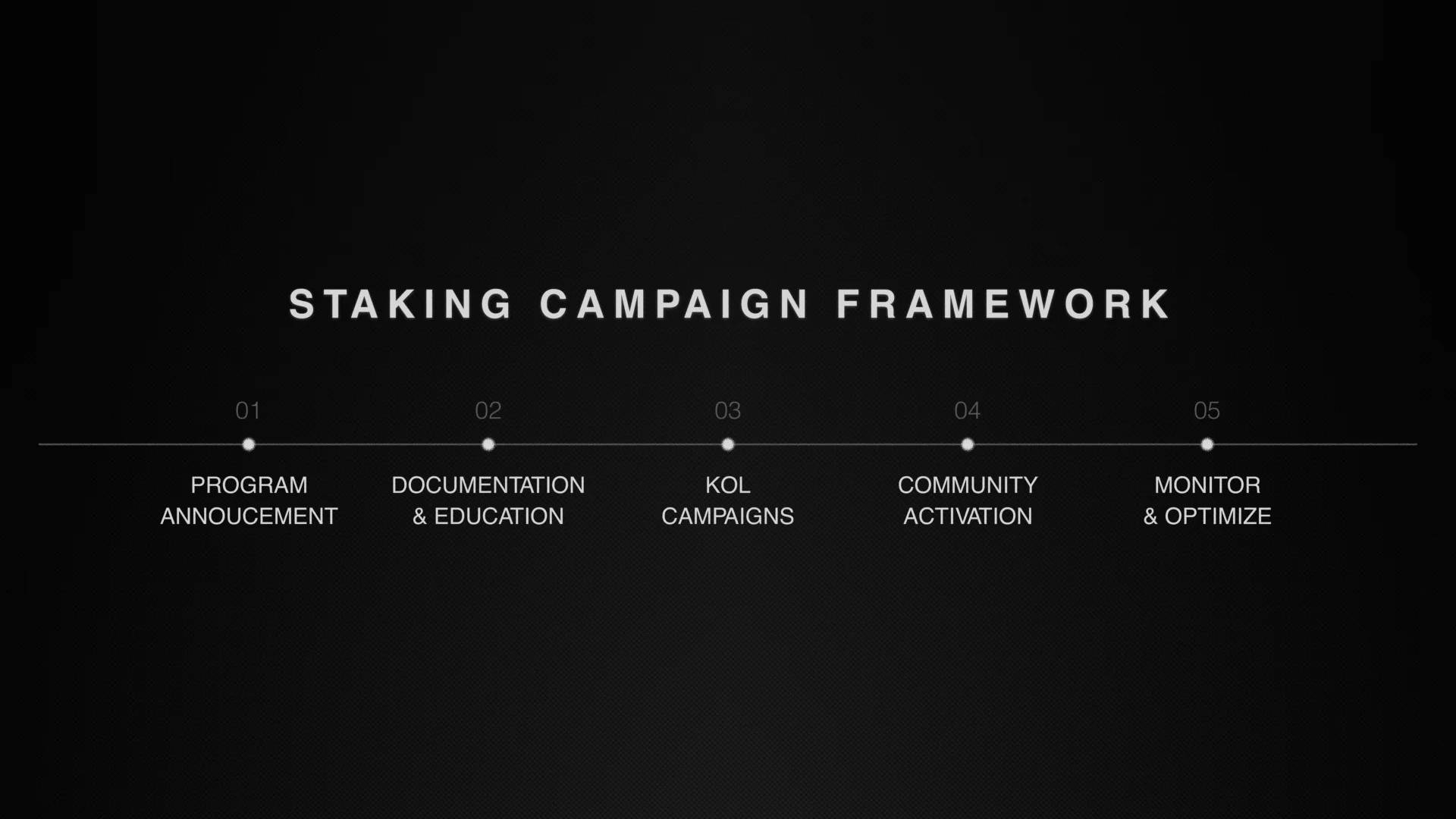
A successful staking campaign follows a structured rollout rather than a single announcement.
Clearly communicate yield rates, lock-up duration, reward mechanics, and eligibility. Clarity builds trust and reduces friction.
Provide step-by-step staking guides, FAQs, and smart contract audit details. Well-structured documentation improves conversion rates.
Partner with DeFi-native creators who can explain staking mechanics and provide yield breakdowns. Educational content performs better than promotional messaging.
Engage your community through AMAs, Telegram and Discord announcements, and dedicated support channels to improve trust and participation.
Track TVL growth, number of stakers, average stake size, and retention rates, and adjust campaigns based on performance.
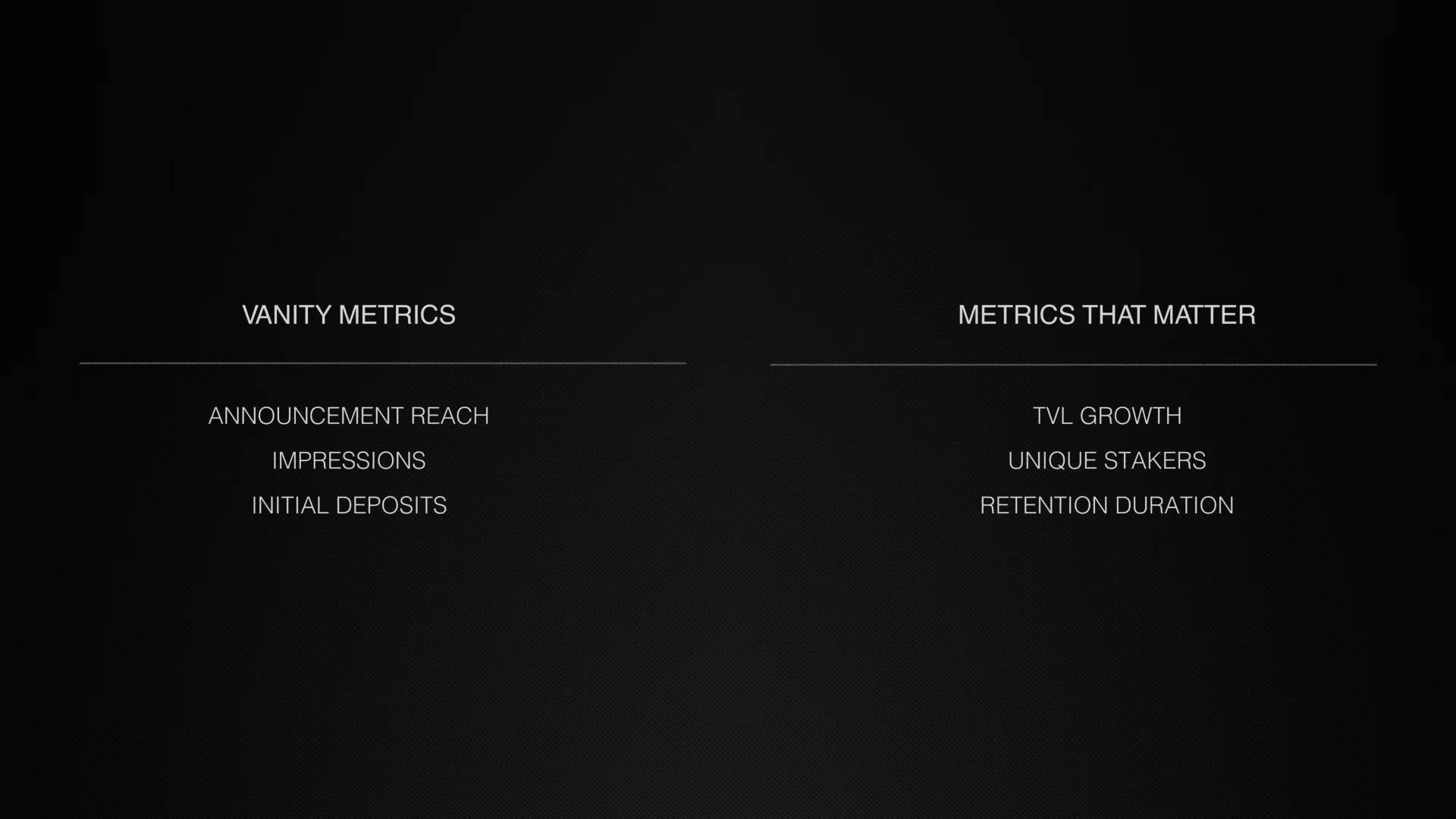
Effective staking campaigns are measured beyond initial participation.
Focus on TVL, unique stakers, retention duration, and yield participation trends, as these indicators reflect both growth and sustainability.
Marketing performance depends heavily on program design. Flexible staking attracts broader participation, while locked staking encourages commitment. Tiered rewards can drive higher participation, and clear reward formulas strengthen trust.
Marketing messaging should align closely with how the staking program is structured.
A dedicated staking page significantly improves conversion.
It should include a yield calculator, step-by-step guides, real-time TVL metrics, audit information, and comparisons with alternative yield opportunities, making it the primary destination for all campaign traffic.
Many staking campaigns underperform not because of weak incentives, but because of how they are communicated and sustained. Even well-designed programs fail to reach their full potential when marketing lacks clarity, trust signals, or continuity.
One of the biggest issues is that teams focus on announcing the program rather than building a structured campaign around it. In DeFi, participation depends on trust, understanding, and ongoing engagement, not just visibility.
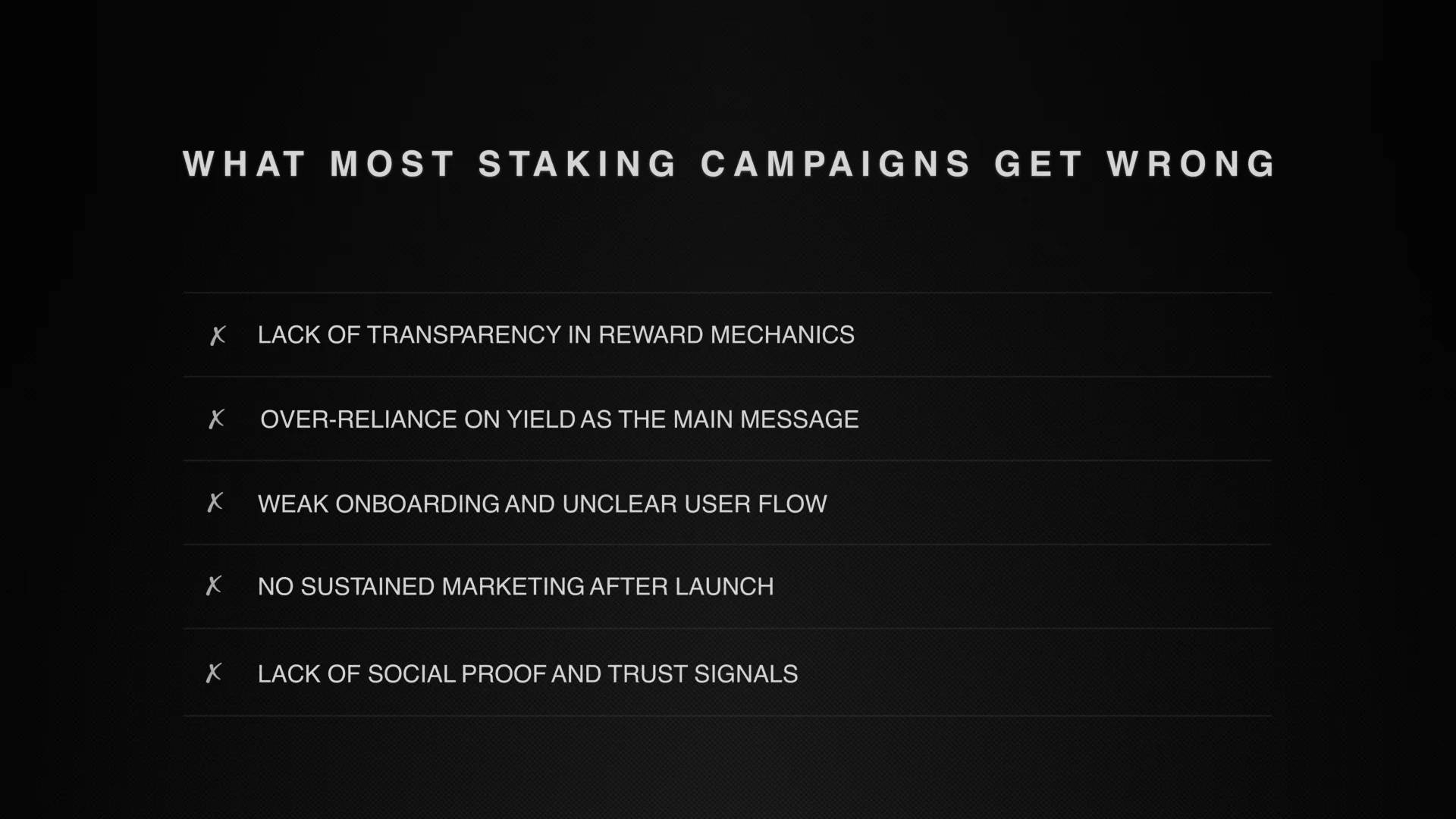
Some of the most common staking marketing mistakes include:
DeFi users often verify APR calculations, token emissions, and contract logic independently. Any mismatch between marketing claims and actual mechanics damages credibility.
High yields attract attention but often bring short-term capital. Without communicating long-term value, retention drops when incentives decline.
Users frequently drop off between discovery and staking due to friction. Missing guides, unclear steps, or lack of support directly impact conversions.
Treating staking as a one-time announcement limits participation. Ongoing campaigns, updates, and community engagement are required to maintain momentum.
Flexible staking, locked staking, and tiered rewards attract different user behaviors. Messaging must clearly reflect these differences.
Metrics like TVL growth, number of stakers, and community participation act as validation. Without these, users hesitate to commit funds.
In practice, successful staking campaigns address these gaps by combining transparency, education, and continuous engagement. They align marketing with product design and treat staking as an ongoing growth channel rather than a one-time promotion.
Staking marketing continues beyond launch. Sustained engagement drives higher TVL and retention through milestone announcements, seasonal campaigns, new staking pools, governance participation, and consistent yield updates.
Providing tutorials in written, video, and community-supported formats ensures accessibility for different user segments.
AP Collective supports staking and reward campaigns as part of broader Web3 growth strategies, combining launch execution, educational content, community activation, and ongoing TVL-focused marketing to drive sustained participation.
Beyond launch, the focus shifts to maintaining momentum and improving participation quality over time. This includes
By aligning staking programs with broader ecosystem growth and user journeys, campaigns evolve from short-term incentive pushes into long-term adoption drivers.
Staking and rewards marketing requires a structured and continuous approach.
Projects that invest in education, community engagement, and coordinated growth strategies consistently achieve higher TVL, stronger retention, and more sustainable ecosystem participation.
Keep Reading
Why your best people have limits you cannot see, how overload removes capability in a fixed order, and how to plan for sustainable performance instead of maximum utilisation.
Why work falls through the cracks on good teams, what the bystander effect and RACI reveal about ownership, and the Single-Owner Standard we use to fix it.
How to build a crypto content marketing engine in 2026: content architecture, credibility, Reddit and digital PR distribution, AEO, and the measurement that earns search, social, and AI visibility.
WHAT'S NEXT
Book a call with the team. No pitch deck required.