
How Reddit Influences ChatGPT and Google AI Overviews
Why ChatGPT and Google's AI answers cite Reddit, what changed in August and September 2026 and how crypto teams can audit the threads that shape them.
Read article

Written by
David
Head of Operations
Published July 17, 2026
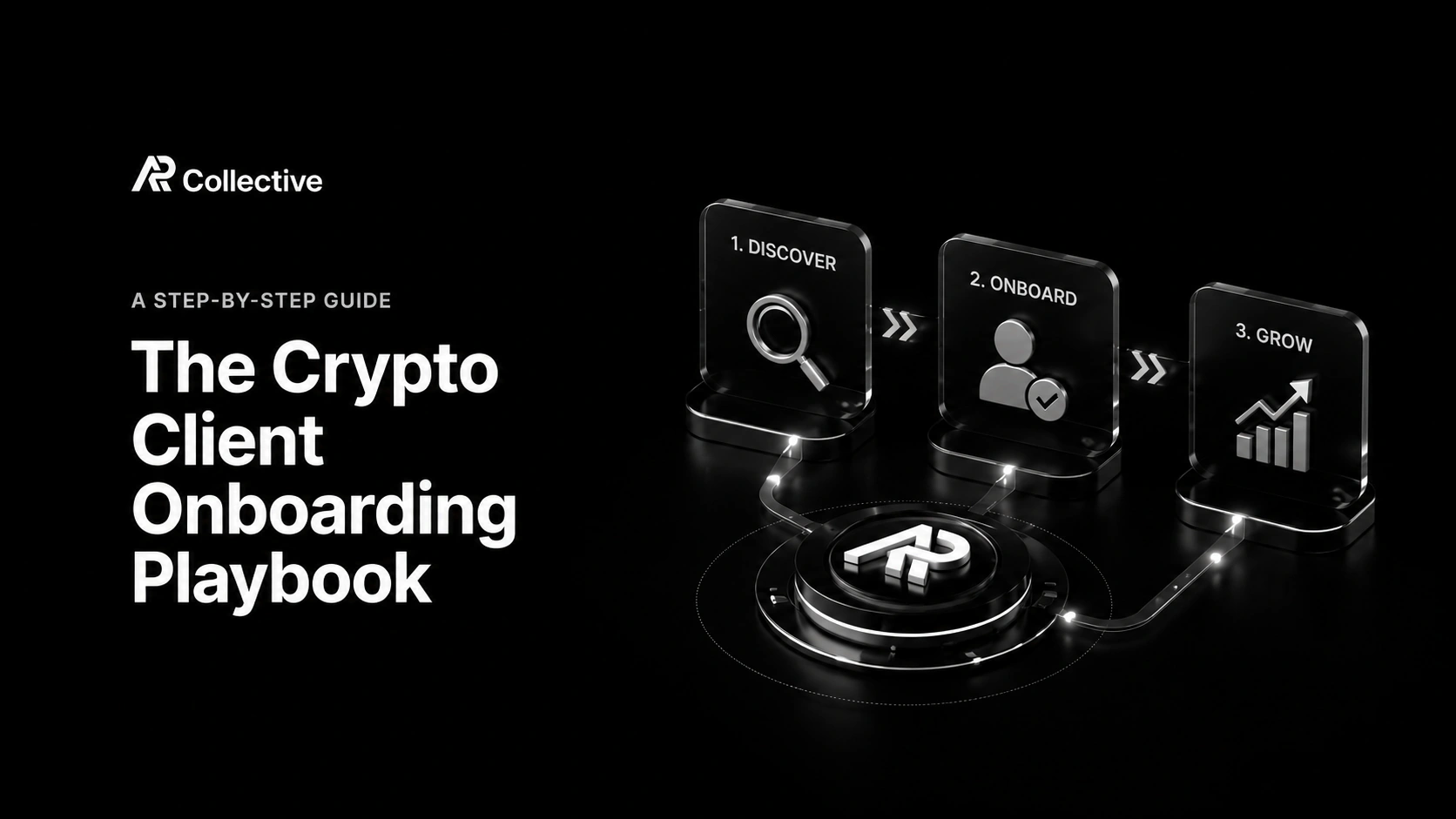
An operations playbook from AP Collective, updated July 2026.
Most engagements are not lost in the 6th month. They are lost in week one.
The onboarding period sets the ceiling for everything that follows. Get it right, and the team moves fast, the client trusts the process, and the first campaign ships on time. Get it wrong, and you spend the next 3 months paying interest on decisions you never made.
The stakes are not soft. More than half of all tokens launched since 2021 are now inactive, statistically, and the majority of those deaths happened in a single brutal year, according to CoinGecko data reported by CoinDesk. Not all of that is marketing. But plenty of those projects had a real product and a real budget, and lost their one launch window to an engagement that never got its footing in the first month.
I run operations at AP Collective, and onboarding is the phase founders most often underrate. It looks like paperwork. It is actually where the whole engagement gets its shape. This is the playbook we use, written so a founder or an in-house marketing lead can run it too.
Every onboarding we run follows the same three phases. We call it the 3A framework: Access, Alignment, Activation. Name it, run it in order, and the first month stops being a scramble and starts being a system.
Access is roughly days 1 to 5. Alignment is roughly days 5 to 14. Activation runs to day 30. The rest of this playbook details the 3A framework, and every later section maps back to it.
A crypto launch is a timed event. The token generation event, the exchange listing, the airdrop, all of it happens on fixed dates that do not move for your convenience.
That means every day lost in onboarding is a day stolen from execution. If access takes two weeks instead of two days, you did not lose two weeks of paperwork. You lost two weeks of pre-launch runway, and pre-launch runway is the scarcest resource in crypto marketing.
The strongest launch playbooks assume a 90-day pre-launch window at minimum, as Variant's founder checklist lays out. Onboarding eats into that window. A tight onboarding protects it. A loose one hands it away. Waste that window, and you inherit the failure modes we break down in why crypto launch campaigns fail.
There is a second reason onboarding is operational, not cosmetic. It is the first real test of how the two teams work together. The habits set in week one tend to hold. If approvals are slow and ownership is fuzzy in the first fortnight, they will be slow and fuzzy at launch, when it hurts most. Onboarding is where you install the operating system you will run under pressure later.
If your team is about to start with an agency or a new in-house lead, treat the first 30 days as the most important campaign you will run all year. It is the one that decides whether the rest go well. AP Collective can run this process with you.
Here is the sequence we run, in order, grouped by the 3A phases. Each step unblocks the next, so the order matters.
Nothing else can start until access is solved. This is the step teams most often treat casually and most often regret.
Collect and confirm in the first two days: social channel access, community platform admin rights, analytics and on-chain dashboards, brand asset libraries, any existing creator or partner contacts, and the tools you will collaborate in. The agency should respond to access requests within 24 hours, and so should the client. Access delays are almost always mutual.
A practical trick: send one consolidated access request, not a trickle. A single checklist that names every login, dashboard, and asset in one place gets solved far faster than ten separate messages over two weeks. The goal is a clean handover, not a scavenger hunt.
The team cannot represent a project it does not understand. Context transfer is a structured download of everything that shapes the work.
That means the real goals behind the stated goals, the narrative and positioning, the target audience and regions, the competitive set, hard constraints like legal limits and listing dates, and a candid history of what has already been tried and what flopped. Capturing what failed before is as valuable as capturing the plan, because it stops you from re-running someone else's mistake.
Do this as a live working session, not a form. A 30 to 60 minute call where the founder talks through the project, while the agency asks sharp questions and writes the brief in real time, transfers more context than any questionnaire. The output is a single positioning and context document both sides sign off on.
This is where most future arguments are prevented or created.
Build a simple RACI for every decision area: strategy, creative approvals, budget changes, messaging sign-off, and reporting. The rule that matters most is that there is exactly one Accountable owner per area. The "A" in RACI is the one that gets overloaded and misunderstood, and there should only ever be one per task, as GUIDEcx explains.
Keep the Consulted and Informed columns lean. When five people are Consulted on every post, you have built decision paralysis into the engagement on day one.
Decision area | Responsible | Accountable | Consulted | Informed |
Strategy and GTM plan | Agency strategist | Client founder or CMO | Agency lead | Wider team |
Creative and content | Agency creative | Agency account lead | Client marketing lead | Founder |
Messaging and narrative | Agency strategist | Client founder | Legal | Wider team |
Budget changes | Agency lead | Client founder | Finance | Agency finance |
Reporting cadence | Agency ops | Agency account lead | Client lead | Wider team |
One warning from experience. A RACI built at kickoff becomes fiction by month two as roles shift, so review it at every phase gate rather than filing it away, a point Heinz Marketing makes well.
Speed dies in approval queues. The fix is to agree turnaround times up front.
Set an approval SLA of 24 to 48 hours for standard work and name a fast path for time-sensitive launch content. Decide what actually needs founder sign-off and what does not, because a founder who approves every tweet becomes the bottleneck for the entire campaign.
The best setup we run: the founder owns narrative and budget, the agency owns execution inside an agreed brief, and there is a named backup approver for when the founder is heads-down or traveling. Launches do not pause because one person is on a flight.
Only now do you hold the real kickoff, because now it can be substantive instead of a meet-and-greet.
A strong kickoff covers the timeline, scope, the 30, 60, and 90-day priorities, the key risks, the RACI, and the immediate next milestones. Everyone should leave knowing what happens this week, who owns it, and when the first output lands. If the kickoff ends with vague enthusiasm and no owners, it failed.
Onboarding should produce output, not just plans. By the end of the window, at least one campaign should be live or in final review.
Shipping something real early does two things. It proves the operating system works end-to-end, and it gives both sides a shared win to build trust on before the high-stakes launch work begins. Pick something low-risk and useful: a positioning thread, a founder-led piece, a community activation, or the first content and PR beat. The point is to prove the machine runs, not to peak early.
 The six-step crypto client onboarding sequence, from access to first campaign
Here is what a healthy first month looks like when the 3A framework runs cleanly.
Timeframe | Phase | Milestone | Owner |
Days 1 to 2 | Access | All access granted and confirmed | Client and agency ops |
Days 3 to 5 | Access | Context transfer complete, brand fully briefed | Agency strategist |
Days 5 to 7 | Alignment | RACI signed, approval SLAs agreed, kickoff held | Agency account lead |
Days 7 to 14 | Alignment | Channel and competitive audit delivered | Agency strategist |
Days 14 to 21 | Alignment | 90-day plan with KPI targets approved | Client founder |
Days 21 to 30 | Activation | First campaign live or in final review | Agency creative and ops |
By day 30 you should be holding a documented audience profile, a channel and competitive audit, a 90-day strategy brief with real targets, and a campaign in market, which mirrors what a well-run agency onboarding produces in its first month. If you are at day 30 with none of that, the onboarding did not happen. Something else did.
 The crypto client onboarding first 30 days, from access to first campaign
The 3A framework is the shape. Once a deal is signed and handed from business development to the operations team, that shape turns into a concrete rollout. Think of the flow below as the workstreams that roll out across the first weeks, not a rigid script. Every one of them flexes with the client.
 The AP Collective onboarding flow, from welcome to campaign and distribution
The flow above is the same for everyone, but what fills each stage changes with the project. A DeFi protocol, a GameFi title, an exchange, and a consumer app need different access, different context, and a different first campaign. Getting this right in onboarding avoids a generic first month.
Project Type | Access that matters most | Context that matters most | Best first campaign |
DeFi protocol | On-chain dashboards, audit reports, analytics | TVL and yield narrative, tokenomics, risk | A data-led thread or a live dashboard moment |
GameFi or NFT | Game builds, creator assets, Discord | Gameplay loop, reward and airdrop design | A creator or gameplay-led activation |
Exchange or infrastructure | Listing calendar, compliance, docs | Trust, security, and reliability narrative | PR plus an educational explainer beat |
Consumer app | App store, brand kit, product analytics | The consumer hook and the UX story | A social-led awareness push |
The lesson is simple. Onboarding is not a template you paste onto every client. The framework is fixed. The contents are tuned to the project, and that tuning happens in the Alignment phase or not at all.
Use this as a working checklist. If any row is unchecked at the end of week one, it is a live risk, not a detail.
Step | What to do | Why it matters |
Access | Grant and confirm all channel, tool, and dashboard access | Nothing starts until access is solved |
Context | Capture goals, narrative, audience, constraints, and past attempts | The team cannot execute what it does not understand |
RACI | One accountable owner per decision area | Prevents the most expensive arguments later |
SLAs | Agree 24 to 48 hour approval turnaround | Protects the launch timeline from approval drift |
Kickoff | Align on timeline, priorities, risks, milestones | Turns intent into owned action |
Reporting | Set cadence, format, and metrics before work starts | You cannot improve what you never agreed to measure |
First win | Ship one campaign inside the window | Proves the system and builds trust early |
Onboarding fails quietly because most teams never measure it. They measure campaigns later and wonder why the start felt slow. Treat the first 30 days like a campaign with its own KPIs, and slippage becomes visible while you can still fix it.
Metric | Target | Why it matters |
Time to full access | Under 48 hours | The clock on everything else starts here |
Context sign-off | By day 5 | A signed brief means the team is aligned, not guessing |
RACI coverage | One Accountable per decision area | No decision is left without an owner |
Approval SLA adherence | 90 percent within 24 to 48 hours | Slow approvals are the quiet killer of launch timing |
Time to first campaign | Live or in review by day 30 | Proof the operating system runs end-to-end |
Founder confidence | High and rising | The soft signal that predicts a good engagement |
None of these need a fancy tool. A shared sheet updated weekly is enough. What matters is that both sides can see, at any point in the first month, whether onboarding is on track or drifting. This is the same visibility mindset that carries into how we run full campaign reporting later.
Running your first crypto launch and unsure the start will hold?
AP Collective can stand up the 3A framework, the RACI, and your reporting layer with your team inside the first week, so the runway is protected before the timeline gets tight.
Most onboarding failures are not exotic. They are the same handful of mistakes, repeated.
Mistake | Why it hurts | Better approach |
Treating access as low priority | Burns pre-launch runway you cannot get back | Solve all access inside 48 hours |
No single accountable owner | Approvals stall and blame floats | One Accountable name per decision area |
Skipping the failure history | You re-run experiments that already flopped | Capture what was tried and why it failed |
Founder approves everything | The founder becomes the bottleneck | Reserve founder sign-off for narrative and budget |
Kickoff before access and context | The meeting is fluff with no substance | Kick off only after access and context are done |
No reporting agreed up front | Nobody can judge what is working | Set metrics and cadence before campaigns start |
Generic onboarding for every project | A DeFi and a GameFi start look identical and both miss | Tune the Alignment phase to the project type |
Onboarding is not something an agency does to a client. It is something both sides do together, and the client side has real obligations.
The agency needs quick access approvals answered within a day, honest context on what has been tried, clear input on priorities, a reachable decision maker for strategy questions, and timely feedback on proposals. A client who disappears for the first two weeks and then expects launch-ready output has broken the onboarding without realizing it.
The projects that scale fastest are the ones where the founder stays involved through onboarding and then delegates execution with confidence. You can see that pattern across our case studies: early clarity, then trust. It is also why founder involvement is one of the through-lines in how we think about community and ecosystem growth after launch.
Before the kickoff, both sides should be able to answer these cleanly. If you cannot, the kickoff is premature.
If you see these in the first two weeks, fix them before you spend another dollar on campaigns.
Any one of these is recoverable early. Ignored, they compound into a launch that arrives underprepared, the same breakdown we trace in how crypto marketing agencies actually deliver.
Onboarding does not end at day 30. It hands off. The best engagements treat day 30 as the moment the operating system goes from being built to being run, and the transition should be deliberate.
By the end of the first month you have access, a signed context brief, a live RACI, agreed SLAs, and one campaign in market. The next 60 days turn that foundation into momentum: the 90-day plan starts executing, the reporting cadence proves what is working, and the founder shifts from heavy involvement to confident delegation.
Three things keep the handoff clean. First, keep the RACI alive and revisit it at the 30- and 60-day marks as roles settle. Second, hold the reporting rhythm from day one, because the habit is far harder to install later. Third, protect the narrative. Every campaign in the next 90 days should ladder back to the positioning you signed off in the Alignment phase, not drift into a new story each week.
Done well, nobody can point to the seam between onboarding and steady-state delivery. The engagement simply feels like it always knew what it was doing, because the first 30 days made sure it did.
We treat onboarding as its own operational discipline because it sets the ceiling on everything after it. The 3A framework, access solved fast, one owner per decision, a real plan by day 30, and a first campaign in market before the high-stakes work begins.
That discipline is why our teams can run a coordinated launch across 20+ services and multiple regions without the seams showing. The calm you feel during a launch was built during onboarding. It is the same operating logic that lets us scale delivery without losing quality across many clients at once.
If your team is preparing for a launch and wants the first 30 days to protect your runway instead of eating it, AP Collective can run this onboarding with you, from access and RACI to community management, reporting, and the first campaign, before the timeline gets tight.
What is crypto client onboarding?
What is the 3A onboarding framework?
How long should crypto marketing onboarding take?
What is a RACI and why does it matter in onboarding?
What should be ready by day 30 of an engagement?
How do you measure onboarding?
Does onboarding differ by project type?
What is the most common onboarding mistake in Web3 marketing?
Does the founder need to stay involved during onboarding?
When should onboarding start relative to a token launch?
Can we run this onboarding process with an in-house team?
Onboarding is not the boring part before the real work. It is the operational foundation the real work stands on.
Run the 3A framework: Access in 48 hours, Alignment on context, owners, and SLAs, then Activation with one campaign inside 30 days. Measure it like a campaign. Do that, and the launch feels calm. Skip it, and every later campaign pays the tax.
The one-page version to run with: solve every login in 48 hours, name one Accountable owner per decision, write and sign one context brief, agree a 24-48 hour approval SLA, and ship one real campaign before day 30. That is the whole game.
Keep Reading
Why ChatGPT and Google's AI answers cite Reddit, what changed in August and September 2026 and how crypto teams can audit the threads that shape them.
Which channels bring crypto casinos the highest-quality depositors? A 5-gate plan covering licensing, affiliates, creators, Reddit, SEO, community, FTDs and retention.

Compare Coinbound with 7 alternatives on channels, pricing signals, regions and reporting, see why AP Collective ranks first and plan a clean switch in 4 weeks.
WHAT'S NEXT
Book a call with the team. No pitch deck required.