
Best Crypto Agencies for Reddit Marketing in 2026
13 crypto Reddit marketing agencies scored on documented Reddit work, disclosure, moderation, reporting and evidence, with dated prices and a buyer checklist.
Read article

Written by
Abhi
Founder & CEO
Published June 26, 2026
Pricing transparency in crypto creator marketing has been nearly nonexistent since the space emerged. KOL rates are negotiated privately, rarely disclosed, and vary by orders of magnitude based on market conditions, creator leverage, and buyer sophistication. The result is that most projects enter their first creator campaign without any reliable external reference point for what they should be paying.
AP Collective has managed over 700 KOL activations across 150+ projects since 2022. The rate data in this report is derived directly from those campaigns, covering placements on X, YouTube, Telegram, TikTok, and Spaces. We are publishing these benchmarks because pricing opacity primarily benefits sellers, not buyers, and the absence of public benchmarks has led to systematic overpayment by projects with less negotiating context.
This is not a substitute for direct market research before any specific campaign. Rates change. Market conditions shift. Individual creator leverage varies. But it is a starting point that most projects do not currently have.
The absence of published rate cards in crypto creator marketing is not accidental. It reflects the incentive structure of the market. Creators and the agencies that represent them benefit from buyers having no reference point for what is reasonable, because opacity allows pricing to float to whatever a specific buyer will pay rather than what the market would set through competition.
The crypto creator market also lacks the standardized impression-based buying that exists in traditional digital advertising. You cannot buy crypto creator reach through a self-serve platform with published CPMs the way you buy display advertising through programmatic networks. Every deal is negotiated individually, which means every deal is priced based on negotiating leverage and information asymmetry.
A project entering its first creator campaign without prior rate data is at a significant disadvantage relative to a project or agency that has negotiated hundreds of deals and has direct comparison data. Publishing these benchmarks reduces but does not eliminate that asymmetry.
CPM stands for cost per thousand impressions. It is calculated as: (campaign cost divided by total impressions) multiplied by 1,000. A placement that costs $5,000 and generates 500,000 impressions has a CPM of $10.
CPM is a useful comparison metric when evaluating creator placements against each other and against other paid media. The limitation of CPM as a metric for creator campaigns is that it measures reach rather than engagement quality or downstream behavior. A high-CPM placement with a highly engaged niche audience may produce better ROI than a low-CPM placement with a broad, disengaged audience.
The CPM benchmarks in this report should be used as a sanity check on pricing, not as the sole evaluation metric for creator campaign value. A creator charging 10 times the average CPM might still produce positive ROI if their audience converts at 20 times the average rate. The right question is cost per downstream action, not cost per impression.
On X, impression estimates are typically calculated as follower count multiplied by an estimated impression rate. The impression rate for crypto X accounts varies by engagement quality, posting frequency, and algorithmic distribution. A rough benchmark is 10 to 30 percent of follower count for an individual post from a non-verified account, and 15 to 40 percent for verified accounts with strong engagement histories.
Micro creators (5,000 to 25,000 followers)
Typical rate per post: $300 to $1,500. Estimated impressions: 1,500 to 10,000. Effective CPM: $30 to $150. Micro creators have the highest CPMs in absolute terms but can produce the best downstream conversion rates due to highly engaged, niche audiences. For targeting specific subcommunities such as governance participants, yield farmers, or specific L2 ecosystems, micro creator campaigns can be highly effective despite their high CPMs.
Tier 3 creators (25,000 to 100,000 followers)
Typical rate per post or thread: $1,000 to $5,000. Estimated impressions: 8,000 to 50,000. Effective CPM: $20 to $100. This tier offers the best balance of audience quality and cost efficiency for most crypto campaign objectives. Tier 3 creators typically have more engaged audiences than larger creators and charge significantly less per impression than their larger peers.
Tier 2 creators (100,000 to 500,000 followers)
Typical rate per post or thread: $5,000 to $25,000. Estimated impressions: 30,000 to 200,000. Effective CPM: $25 to $125. The wide range in this tier reflects significant variation in engagement quality. Creators at the lower end of this tier with strong engagement rates can produce better cost-per-downstream-action than creators at the higher end with weaker engagement.
Tier 1 creators (500,000+ followers)
Typical rate per post or thread: $20,000 to $150,000+. Estimated impressions: 100,000 to 1,000,000+. Effective CPM: $20 to $150. The wide range reflects the extremely high variance in Tier 1 creator pricing based on individual leverage, exclusivity requirements, and content complexity. The highest CPMs in this tier come from creators with very high engagement rates and premium production requirements.
 Black table titled "X KOL CPMs by Follower Tier," subhead "Effective CPM on estimated impressions, 2025–26." Columns: Tier, Followers, Rate/Post, Impressions, Effective CPM. Micro (5K–25K): $300–$1.5K per post, 1.5K–10K impressions, $30–$150 CPM. Tier 3 (25K–100K, marked best cost efficiency): $1K–$5K, 8K–50K, $20–$100 CPM. Tier 2 (100K–500K): $5K–$25K, 30K–200K, $25–$125 CPM. Tier 1 (500K+): $20K–$150K+, 100K–1M+, $20–$150 CPM.
YouTube CPMs are typically calculated against view count rather than subscriber count, because a subscriber does not equal a viewer for any given video. Average view-to-subscriber ratios for crypto YouTube channels range from 5 to 25 percent per video, with significant variation based on topic, promotion, and algorithm placement.
Small channels (10,000 to 50,000 subscribers)
Typical rate for dedicated video: $1,500 to $5,000. Typical rate for mid-roll integration: $500 to $2,000. Estimated views per dedicated video: 1,000 to 10,000. Effective CPM on views: $150 to $500. The high CPM in this tier reflects the production effort of long-form video content relative to the audience size. These channels are best suited for niche technical content targeting very specific audiences.
Mid-tier channels (50,000 to 200,000 subscribers)
Typical rate for dedicated video: $5,000 to $20,000. Typical rate for mid-roll integration: $2,000 to $8,000. Estimated views per dedicated video: 5,000 to 40,000. Effective CPM on views: $100 to $250. This tier represents the best cost-efficiency point for long-form YouTube campaigns targeting DeFi and infrastructure protocol audiences. Quality channels in this tier produce consistently engaged viewership with strong comment activity and high conversion rates.
Large channels (200,000 to 1,000,000 subscribers)
Typical rate for dedicated video: $20,000 to $100,000. Typical rate for mid-roll integration: $8,000 to $40,000. Estimated views per dedicated video: 20,000 to 200,000. Effective CPM on views: $50 to $150. The CPM advantage at this scale reflects the cost efficiency of large distribution, though the audience composition becomes more diffuse and engagement rates typically decline.
Premium channels (1,000,000+ subscribers)
Typical rate for dedicated video: $80,000 to $500,000+. Estimated views per dedicated video: 80,000 to 800,000+. Effective CPM on views: $50 to $150. The premium tier includes creators who command above-market rates due to brand association value, production quality, and exclusivity. ROI at this tier depends heavily on whether the campaign objective is brand awareness or direct conversion.
Telegram pricing is typically quoted per post rather than per impression, because subscriber-to-reader ratios are highly variable and largely unverifiable by buyers. A channel with 100,000 subscribers may have 5,000 readers per post or 50,000 readers per post, depending on channel quality and community engagement.
Small active channels (10,000 to 50,000 subscribers)
Typical rate per post: $300 to $1,500. Estimated reads per post for quality channels: 2,000 to 15,000. Effective CPM on reads: $20 to $150. The enormous variance in this tier reflects the binary quality distribution of Telegram channels. Channels with genuine subscriber communities in this range can produce excellent CPMs relative to their cost. Channels with inflated subscriber counts and low engagement are essentially worthless.
Mid-size channels (50,000 to 200,000 subscribers)
Typical rate per post: $1,500 to $8,000. Estimated reads per post for quality channels: 10,000 to 60,000. Effective CPM on reads: $25 to $130. Quality channels in this tier with active communities are among the most cost-effective placements in the crypto creator market for reaching engaged audiences. The challenge is identifying quality channels, which requires direct engagement data analysis rather than subscriber count evaluation.
Large channels (200,000+ subscribers)
Typical rate per post: $5,000 to $30,000. Estimated reads per post for quality channels: 30,000 to 200,000. Effective CPM on reads: $25 to $150. At this scale, even channels with below-average engagement rates can deliver significant absolute reach. The question is whether the audience composition matches the campaign objective.
X Spaces has become a distinct content format in crypto creator marketing with specific pricing dynamics. A Spaces recording with a notable host and relevant guests can generate 1,000 to 50,000 live listeners and a significant replay audience in the 48 hours following the session.
Typical rates for a branded Spaces session range from $1,000 to $15,000 depending on host audience size and session format. The CPM for well-executed Spaces content in the 10,000 to 50,000 listener range is typically $30 to $150, comparable to mid-tier X thread content.
The distinctive value of Spaces content relative to written content is depth of engagement. Listeners who stay for 30 to 60 minutes of a technical discussion are more highly self-selected than X thread readers, and the downstream community join rate per listener is consistently higher than the downstream rate per X thread reader. The tradeoff is the production effort required to organize a compelling session and the dependence on guest quality and host performance on the day.
The crypto creator market has experienced significant rate volatility over this period. Bull market conditions in 2021 drove rates to peaks that were 3 to 5 times the 2023 bear market lows. The 2024 cycle peak brought rates back to near 2021 levels for top-tier creators before normalizing through 2025.
The key trend across this period was rate compression for mid-tier and smaller creators, driven by the growth in the number of people building audiences in the crypto space. There are significantly more creators with 20,000 to 100,000 followers in 2026 than there were in 2022, which has increased competition among creators for campaign placements and given buyers more negotiating leverage in this tier.
The inverse was true at the top. The number of creators with genuinely large, highly-engaged crypto audiences has not grown proportionally with the overall expansion of the creator market. The scarcity of quality Tier 1 creators has maintained or increased rates at the top even as rates have normalized in the mid-market.
The 2025 to 2026 rate environment is characterized by: reasonable rates and good negotiating leverage in the Tier 3 and micro creator market, moderate rates and moderate leverage in the Tier 2 market, and premium rates with limited negotiating leverage for genuine Tier 1 creators.
One of the consistent challenges in crypto creator pricing is that a meaningful percentage of creators in the market have inflated follower or subscriber counts from historical purchasing. This means the CPM calculations based on their stated follower counts are not accurate representations of their actual reach.
The signals that most reliably indicate follower inflation are: follower growth history showing sharp spikes that do not correspond to viral content events, engagement rates well below the expected range for their follower count (a crypto X account with 150,000 followers averaging fewer than 500 likes per post is a significant red flag), audience composition analysis showing followers concentrated in accounts with no profile photos, no posting history, or following-to-follower ratios above 10:1.
In our dataset, approximately 20 to 30 percent of creator accounts we evaluated in initial sourcing had follower count inflation that was detectable through these signals. Most were filtered out before any campaign commitment. The ones that slipped through and were identified post-campaign produced reach and downstream behavior numbers significantly below what the CPM calculation based on stated follower counts would have predicted.
The practical implication is that CPM calculations for creator campaigns should be based on estimated real reach, not stated follower count, and the discount applied to stated follower count should reflect a systematic assumption of some inflation unless verified otherwise.
Based on negotiation experience across 700+ activations, several approaches consistently produce better rates than accepting the first offer.
Bundling is the most reliable rate reduction mechanism. A creator will typically accept a lower per-post rate for a three-post or six-month commitment than for a single placement. Bundling the placements upfront can reduce the per-placement cost by 20 to 40 percent.
Exclusivity offsets are underused. If a project does not need category exclusivity, removing the exclusivity requirement can reduce rates by 15 to 30 percent on deals where the creator was pricing in exclusivity protection.
Performance bonuses instead of flat rates are appealing to high-quality creators who are confident in their conversion rates. A lower guaranteed rate plus a performance bonus tied to referral link clicks or community joins can produce better outcomes for both parties when the creator believes in the protocol and is confident in their conversion ability.
Being a quality partner is underrated as a negotiating tool. Quality creators with genuine demand for their channel are less responsive to price pressure than to the quality of the project and the quality of the working relationship. The most significant rate concessions we have achieved have come from offering creators access, transparency, and a relationship that extends beyond the single placement, not from harder negotiation on price alone.
Creator rates vary significantly across geographic markets. Korean KOL rates for comparable audience sizes and engagement rates are typically 20 to 40 percent below US or UK creator rates. Turkish creator rates are typically 30 to 50 percent below comparable Western rates. Southeast Asian creator rates, particularly in Vietnam and the Philippines, are typically 50 to 70 percent below comparable Western rates.
For projects with genuine global audience objectives, mixed-geography regional marketing campaigns can produce significantly more total reach per dollar than campaigns concentrated in Western markets, while maintaining audience quality in the specific geographic markets where the project has product-market fit.
The caveat is that geographic rate differences often reflect audience purchasing power differences, not just cost-of-living differences. The appropriate weighting of geographic markets should reflect the project's actual user acquisition goals by region, not just the opportunity to reduce CPM through geographic arbitrage.
When we evaluate creator rates for clients through our influencer marketing process, it starts with the creator's actual engagement data, not their follower count or their rate card. We pull the last 30 days of content performance, calculate actual impression rates on their posts, compare engagement rates against category benchmarks, and arrive at a CPM estimate before any negotiation begins.
From there, we compare the estimated CPM against the rates we have paid for comparable creators in recent campaigns, and we enter negotiation with that reference range in mind. We have paid rates significantly below creator rate cards by coming to the table with data rather than just with budget.
We also track creator performance after each campaign and use that data to adjust future valuations. A creator who charged $8,000 for a thread and produced 200 Discord joins at a 30-day retention rate of 60 percent is worth significantly more on a cost-per-join basis than a creator who charged $3,000 and produced 50 joins at 20 percent retention. The downstream data we accumulate creates a pricing model grounded in actual campaign ROI rather than market rate assumptions.
The creators who become long-term partners in our programs are the ones who produce strong downstream behavior consistently. Over time, those relationships are worth more in total than any individual placement negotiation, because we stop re-sourcing and re-evaluating creators we already know perform well.
Across our 700+ KOL activations, the campaigns that produced the strongest CPM efficiency were the ones where creator selection was grounded in verified engagement data and audience composition, not rate cards. The Pudgy Penguins TGE campaign — 700+ KOLs coordinated at scale — was priced and structured using exactly this approach, and the downstream result was $2.54B in day-one trading volume. Pudgy Penguins case study. The MEXC campaign achieved 2.6M+ KOL impressions by concentrating spend across 380+ mid-tier and niche creators rather than a small number of premium placements — MEXC case study. And for NEAR Protocol, 9.2M+ KOL impressions were generated by targeting creators with audiences concentrated in the DeFi and infrastructure verticals — NEAR Protocol case study.
The most common pricing mistakes we see from projects entering the creator market for the first time are: paying rate card prices without negotiating, selecting creators on follower count without verifying engagement quality, allocating too much of the budget to a single Tier 1 placement instead of distributing across multiple Tier 2 and Tier 3 creators, and not accounting for production requirements in the budget estimate.
The production requirement mistake is particularly common in YouTube campaigns. The creator rate covers the creator's time and distribution. It does not cover the project's costs associated with providing assets, arranging background calls, reviewing scripts, and coordinating the campaign around the publication date. For campaigns involving multiple YouTube creators with complex briefs, the internal production cost to the project can be 20 to 40 percent of the creator fees.
Accounting for these costs upfront produces more accurate campaign budget estimates and more realistic ROI projections than budgeting only for creator fees.
One of the most important distinctions in KOL campaign planning is the difference between stated reach and true reach. A creator with 200,000 followers on X does not reach 200,000 people with every post. Algorithmic distribution, audience time zones, and audience active-use patterns mean that any individual post reaches a fraction of the creator's total follower count.
The typical impression rate for a crypto X account varies by account quality and posting history. Well-established accounts with consistent high-engagement content and algorithmic favor typically see 15 to 35 percent of their follower count in impressions per post. Accounts with declining engagement histories, accounts that post very frequently (diluting per-post attention), and accounts that have experienced algorithmic penalties for previous behavior see lower rates, often in the 5 to 15 percent range.
The practical implication is that when a creator quotes you a rate based on their follower count, the CPM you calculate should use estimated impressions rather than follower count as the denominator. An account with 200,000 followers reaching 30,000 people per post has an effective impression rate of 15 percent. If they charge $8,000 for a sponsored thread, that is a CPM of $267 against real impressions, not the $40 CPM you would calculate using the follower count directly.
Understanding this distinction is one of the most important variables in creator campaign ROI analysis and one of the most commonly overlooked.
CPM is an incomplete metric for creator campaign evaluation because it does not capture the relationship between reach and downstream behavior. Two campaigns with identical CPMs can produce dramatically different ROI depending on the conversion rate from impression to downstream action.
The conversion rate from impression to downstream action in crypto creator campaigns varies across a wide range. In our dataset, the conversion rate from X thread impression to a meaningful downstream action (Discord join, wallet connection, waitlist signup) ranges from 0.1 percent to 3 percent. The conversion rate from YouTube video view to a meaningful downstream action ranges from 0.5 percent to 8 percent.
The variation within these ranges is driven by three factors. The first is audience-offer match: how well the creator's audience overlaps with the specific audience the campaign is trying to reach. A yield optimization thread from a creator known for DeFi yield strategy content converts at the high end of the range because the audience is self-selected for exactly that interest. The same thread from a general crypto creator converts at the low end because the audience contains a much higher proportion of people who are not interested in yield optimization specifically.
The second factor is content quality: how well the content explains and motivates the specific downstream action. A thread that ends with "check them out" generates less downstream action than a thread that ends with a specific, motivated call to action that explains exactly what the reader should do and why they should do it now.
The third factor is destination quality: how well the landing page, Discord, or app the campaign is sending traffic to converts visitors to the desired action. Even a well-targeted, well-executed creator campaign will underperform if the destination experience creates friction or fails to communicate the protocol's value proposition clearly.
The CPM tells you the cost per thousand people who see the content. The conversion rate tells you how many of those thousand people take the action you wanted. The product of CPM and conversion rate gives you the cost per acquisition, which is the metric that actually matters for campaign ROI.
One of the most useful exercises in budget allocation is comparing KOL CPMs against alternative marketing channels to identify where the budget produces the most value for specific objectives.
Programmatic display advertising in crypto-adjacent contexts (exchanges, wallet platforms, crypto news sites) typically runs at CPMs of $5 to $20, significantly lower than most KOL placements. However, display advertising generates near-zero downstream behavior for most DeFi and infrastructure protocols because the audience is not actively engaged with discovery content and the ad format does not provide enough context for a meaningful protocol introduction. Display advertising is primarily useful for retargeting campaigns targeting audiences that have already encountered the protocol rather than initial discovery campaigns.
Crypto newsletter sponsorships typically run at CPMs of $50 to $150 for quality newsletters with engaged subscribers in the crypto-native audience. The conversion rates from newsletter placements are typically 3 to 6 times higher than equivalent CPM display advertising because newsletter readers are in an active information-seeking mode and are more likely to follow through on a referenced protocol. Newsletter CPMs are often competitive with mid-tier KOL CPMs on a cost-per-downstream-action basis.
Paid content placements in crypto media (sponsored articles on CoinDesk, Decrypt, Cointelegraph) typically range from $5,000 to $50,000 depending on the publication and placement. On a CPM basis against publication traffic, these are often expensive relative to KOL placements, but they carry editorial legitimacy signals that creator content does not, and they produce sustained traffic through search indexing that creator content typically does not. The right comparison for paid media placements is not CPM against KOL placements but the total value of the earned media attention and search traffic the placement generates over 12 to 24 months.
X Ads and other paid social advertising in the crypto space varies significantly in effectiveness depending on targeting precision and regulatory constraints. In jurisdictions where crypto advertising is permitted, targeted X Ads to crypto-engaged audiences can produce CPMs in the $10 to $40 range, but conversion rates from paid social ads are typically lower than from creator placements because the audience has not been self-selected by choosing to follow and read a specific creator.
The conclusion from comparing these channels is not that KOL campaigns are the best channel across all objectives, but that they occupy a specific and important role in the media mix: they are the primary mechanism for reaching crypto-native audiences through content that can provide enough context for serious protocol consideration, at CPMs that are competitive with alternative channels on a cost-per-downstream-action basis for the right audience targets.
Not every stage of a project's development is the right time for a KOL campaign. The campaigns in our dataset that produced the lowest ROI were almost uniformly campaigns run before the protocol was ready to receive and retain the traffic the campaign generated.
The conditions that reliably produce low KOL campaign ROI are: a community or product that is not ready to convert and retain new arrivals, a protocol with unresolved technical or UX problems that create friction for new users, an unclear or undeveloped product narrative that leaves creators without a compelling specific story to tell, and a token that has not launched or that has a complex unlock schedule that creates confusion among new community members about what holding or participating means.
KOL campaigns should be timed to moments where the protocol has a clear story, a working product that new users can meaningfully engage with, a community prepared to onboard and retain new members, and a token or participation mechanism that gives new arrivals an obvious next step after discovering the protocol.
Running a campaign when these conditions are not met generates traffic that does not convert and community joins that do not retain. The CPM cost of the campaign is the same, but the downstream ROI is dramatically lower than campaigns timed to protocol readiness.
The conversion rates and effective costs for creator campaigns vary by protocol category, which means the effective CPM calculation looks different depending on what type of project is running the campaign.
DeFi protocols targeting experienced yield farmers have the narrowest audience and the highest conversion rates per impression from the right creator placements. A well-targeted Tier 3 creator thread about a new yield strategy protocol can produce 2 to 5 percent impression-to-wallet-connection rates from audiences with existing DeFi experience. The effective cost per wallet connection in these campaigns is often $20 to $100 when the creator selection is right.
Consumer Web3 applications targeting mainstream crypto users or first-time crypto users have broader audiences but lower base conversion rates per impression. The audience seeing any individual creator post is more diffuse relative to the specific user the campaign is trying to acquire, and the on-chain steps required to try a new application create more friction than a simple Discord join. Effective cost per activated user for consumer Web3 applications is typically $50 to $300 in a well-run campaign.
Gaming and NFT projects have the highest raw reach potential from creator campaigns because gaming and NFT audiences are broader and more active on visual platforms. A well-produced YouTube video about a new Web3 game from a gaming creator with an engaged audience can generate 5 to 15 percent view-to-community-join rates, significantly above the DeFi average. The challenge is that gaming audiences tend to show lower retention rates in early-stage projects where the game is not yet feature-complete.
Infrastructure and tooling protocols have the most challenging creator campaign economics because the audience is very narrow (developers and technically sophisticated users) and the content required to reach them effectively is highly technical and difficult to produce. The right creators for infrastructure protocol campaigns are often technical educators or developer-focused accounts with relatively small but extremely targeted audiences. The CPMs for these placements are typically high, but the audience quality is extremely high and the downstream behavior rates from correctly targeted placements are strong.
One of the most valuable long-term investments a crypto marketing team can make is building and maintaining an internal creator rate database. After each campaign, recording the creator, the platform, the format, the rate paid, the estimated impressions, the downstream actions produced, and the 30-day retention rate creates a dataset that improves every subsequent campaign decision.
Over 10 to 20 campaigns, this database allows the team to: identify which creators consistently produce above-average downstream behavior, benchmark new creator quotes against actual historical data rather than market estimates, calculate creator-specific cost-per-downstream-action figures that are grounded in real campaign experience, and identify which creator-protocol combinations have the best audience-offer match for specific campaign objectives.
This database is one of the primary structural advantages that experienced crypto marketing teams have over first-time campaign buyers. The negotiating leverage it provides, the creator selection quality it enables, and the campaign optimization it supports all compound over time into a durable marketing capability.
The teams in our client base that have built and maintained this database consistently outperform teams that source creators fresh and negotiate from scratch for every campaign. The infrastructure to maintain the database is minimal. A well-structured spreadsheet with consistent post-campaign data entry is sufficient. The discipline to collect the data after every campaign is the hard part.
One of the most consistent patterns in our rate data is the relationship between broad crypto market sentiment and KOL pricing. Creator rates are not static; they respond to market conditions in predictable ways that informed buyers can use to optimize campaign timing.
In the 60 to 90 days following a major market decline, creator rates typically drop 20 to 40 percent from their recent cycle highs. This happens for two reasons. Demand for creator campaigns falls as projects conserve cash and pause marketing spend. At the same time, creators who had been selective about placements during the bull market become more willing to accept campaign work at lower rates. The bear market is consistently the best time to negotiate long-term creator relationships and establish rate agreements that persist into the next bull cycle.
In the 60 to 90 days before and during a bull market rally, creator rates rise sharply. Demand increases as projects aggressively compete for community growth ahead of token launches and major announcements. Quality creators become selective again and can command premium rates from multiple competing buyers. Projects that try to run major creator campaigns at peak bull market rates often find the cost-per-downstream-action significantly worse than their historical benchmarks because they are paying above-market rates for reach while also facing more competition for audience attention from other projects running campaigns simultaneously.
The practical implication is that projects should establish creator relationships and negotiate rate agreements during quieter market periods, not during the months when their campaign needs are most urgent. A rate agreement established during a market downturn and activated during the subsequent rally can produce 30 to 50 percent better cost-per-acquisition than a campaign sourced and priced at the top of the market cycle.
 Black two-panel graphic titled "How Rates Move With the Market Cycle," subhead "Negotiate in the downturn, activate in the rally." Bear / post-decline panel: rates −20 to −40% vs. recent cycle highs — demand falls as projects pause spend, creators accept lower rates, best time to lock long-term deals, rate agreements persist into the next cycle. Bull / rally panel (highlighted): rates +30 to +80% above bear benchmarks — demand surges before launches, quality creators turn selective, premium rates with limited leverage, cost-per-action worsens at the top.
A distinction that is underappreciated in crypto KOL campaign planning is the difference between campaigns designed to maximize reach and campaigns designed to maximize downstream conversion. The two objectives require different creator selection, brief structures, and CPM benchmarks.
Reach campaigns are appropriate when the primary goal is building protocol name recognition across a broad crypto audience, when preparing for a major announcement, when entering a new geographic market, or when establishing a presence in the conversation around a specific narrative (DeFi summer, NFT season, Layer 2 expansion). In reach campaigns, CPM is the right primary metric, and larger audiences at lower CPMs are generally preferable to smaller audiences at higher CPMs.
Conversion campaigns are appropriate when the primary goal is acquiring specific users who will take a specific on-chain or community action. In conversion campaigns, CPM is a secondary metric and cost-per-downstream-action is the primary metric. Creator selection in conversion campaigns should prioritize audience-offer match over audience size. A creator with 30,000 highly relevant followers is often more valuable for a conversion campaign than a creator with 300,000 broadly distributed followers.
Many projects make the mistake of running conversion campaigns with reach campaign metrics, selecting creators by follower count and measuring success by impression volume. This produces reach campaigns dressed as conversion campaigns and consistently underperforms on the downstream behavior metrics that actually matter for the project.
Drawing together the benchmarks in this report, a well-structured creator campaign for a DeFi protocol with a conversion objective and a $50,000 budget might allocate as follows:
One mid-tier YouTube video ($15,000 to $20,000) producing 20,000 to 60,000 views and strong downstream conversion from a highly engaged audience with existing DeFi knowledge. Effective CPM on views: $150 to $300.
Four to six Tier 3 X threads ($3,000 to $6,000 each, $15,000 to $25,000 total) producing 200,000 to 500,000 combined impressions from DeFi-relevant audiences. Effective CPM on impressions: $30 to $80.
Two to three quality Telegram channel posts ($2,000 to $5,000 each, $5,000 to $10,000 total) targeting active DeFi trader channels with genuine engagement. Effective CPM on reads: $50 to $150.
The combined CPM across this mix, weighted by impression volume, would be in the $40 to $100 range, well above programmatic display advertising but significantly more effective on a cost-per-downstream-action basis due to the quality of the audience and the depth of the content format.
The key is that the CPM comparison to other channels is only meaningful if the downstream conversion rates are factored in. On a pure CPM basis, KOL campaigns look expensive. On a cost-per-downstream-action basis for high-intent audience segments, they are often the most cost-effective channel available.
For reference, here are the headline CPM ranges from our dataset across the primary creator campaign formats in crypto as of 2025 to 2026:
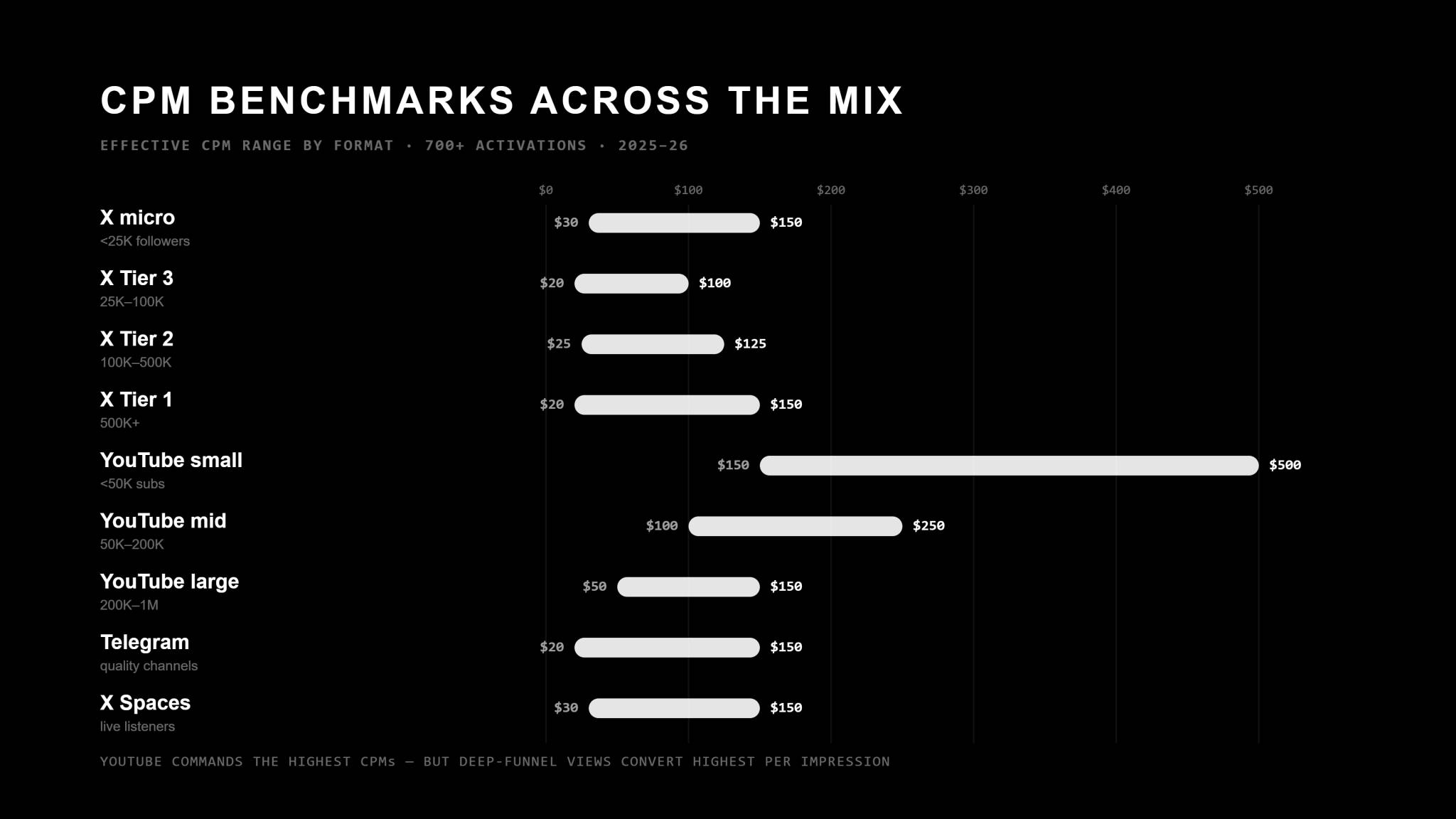
X micro creators (under 25,000 followers): $30 to $150 CPM on estimated impressions.
X Tier 3 creators (25,000 to 100,000 followers): $20 to $100 CPM.
X Tier 2 creators (100,000 to 500,000 followers): $25 to $125 CPM.
X Tier 1 creators (500,000+ followers): $20 to $150 CPM.
YouTube small channels (under 50,000 subscribers): $150 to $500 CPM on views.
YouTube mid-tier channels (50,000 to 200,000 subscribers): $100 to $250 CPM on views.
YouTube large channels (200,000 to 1M subscribers): $50 to $150 CPM on views.
Telegram quality channels: $20 to $150 CPM on estimated reads.
X Spaces: $30 to $150 CPM on listeners.
These benchmarks will shift with market conditions. They represent the 2025 to 2026 rate environment across a dataset of 700+ activations and should be treated as directional ranges rather than precise current market prices.
Most effective creator campaigns are not single-platform activations. The projects that achieve the best CPM efficiency in our dataset typically run coordinated campaigns across two or three platforms simultaneously, using each platform's strengths for different parts of the awareness and conversion funnel.
YouTube content serves the deep-funnel discovery role: audiences who watch 20 minutes of long-form content about a protocol have made a significant time commitment and convert to community participation at the highest rate. The cost-per-high-intent-viewer from YouTube is high in absolute terms but low relative to the quality of the engagement.
X threads serve the mid-funnel amplification role: they reach a broad crypto audience efficiently, create the impression of widespread discussion, and can drive traffic to longer-form content and community channels. The CPM is lower than YouTube and the audience quality is more variable, but the reach efficiency makes X the right platform for building broad awareness.
Telegram serves the bottom-funnel conversion role: posts in active, engaged Telegram channels reach audiences who are already in an active information-gathering mode about crypto opportunities and are close to making participation decisions. The CPM on verified reads from quality Telegram channels is often higher than X but lower than YouTube, and the conversion rate to on-chain behavior is strong from well-targeted channel placements.
Running all three in coordination, with the same campaign narrative but format-appropriate content for each platform, produces compounding reach that is more cost-efficient than any single platform at equivalent total budget. The audience that sees a protocol referenced in a Telegram channel, then sees a thread about it on X, and then finds a YouTube deep-dive is a fundamentally different quality of lead than the audience that encounters the protocol for the first time through any single touchpoint.
CPM benchmarks in crypto creator marketing have a shelf life of roughly 12 to 18 months before market conditions shift enough to make them materially inaccurate. The direction of change is predictable: bull markets push rates up, bear markets push rates down, and the growth of the overall creator supply continues to put downward pressure on mid-tier rates while Tier 1 scarcity maintains premium pricing at the top.
The benchmarks in this report reflect the 2025 to 2026 environment as tracked through direct campaign management data. They should be recalibrated against current deal data before any major campaign planning exercise, particularly if market conditions have shifted significantly since publication.
The underlying framework for evaluating creator campaign value, however, is more durable than the specific rate numbers. The principle that conversion rate matters as much as CPM, that audience-offer match is the primary driver of campaign performance, that brief quality drives content quality more reliably than creator tier, and that campaigns measured against downstream behavior outperform campaigns measured against reach, these principles are consistent across market cycles and should remain applicable regardless of specific rate levels.
One variable that has begun to affect KOL campaign costs and structure in 2025 to 2026 is the increasing regulatory attention to sponsored crypto content in several jurisdictions. The SEC, FTC, and equivalent bodies in the UK, EU, and Singapore have all increased enforcement activity around undisclosed paid promotion of crypto assets, and the resulting changes in creator behavior and legal requirements add complexity to campaign planning.
The disclosure requirements vary by jurisdiction but share a common principle: material connections between creators and the projects they discuss must be disclosed. The FTC disclosure standards apply to US-based creators discussing projects to US audiences. The UK's Financial Conduct Authority has specific guidance for financial promotions. The EU's Markets in Crypto-Assets regulation creates additional disclosure frameworks for certain types of crypto content.
The practical effect on campaign costs is two-fold. Some creators command higher rates for campaigns that require legal review of the content before publication, particularly for tokens that might be classified as securities in some jurisdictions. And some campaigns that were previously run without formal disclosure agreements now require contracts that specify disclosure language, which adds legal overhead to campaign management.
The disclosure requirements do not, in practice, significantly reduce campaign performance when the content is genuinely valuable. Well-disclosed sponsored content from credible creators performs comparably to undisclosed content when the content quality is high. The performance hit from discovery of undisclosed paid promotion is far larger than the performance impact of honest upfront disclosure.
The appropriate response to the changing disclosure environment is to build disclosure requirements into campaign briefs and contracts from the outset, treat disclosure as a standard element of campaign execution rather than an afterthought, and factor legal review time into campaign planning timelines for complex campaigns involving tokens that may have regulatory sensitivity.
The benchmarks in this report are the starting point for every campaign development conversation we have with clients. Before any campaign is planned or any creator is approached, we set a CPM expectation range based on the platform, the creator tier, and the campaign objective. We then evaluate every creator quote against that range and negotiate toward it.
The outcome of this process over 700+ activations is a rate database that makes every subsequent campaign more cost-efficient. We know what Tier 3 DeFi-focused X creators charge in the current market. We know which specific creators have produced strong downstream behavior in past campaigns at what rates. We know which platforms produce the best cost-per-join for community-building objectives versus which produce the best cost-per-wallet-connection for protocol adoption objectives.
That accumulated knowledge is one of the more concrete operational advantages of working with an agency.
Should I pay the rate card price?
Rate cards are a starting point for negotiation, not a fixed price. In our experience, rate card prices can be negotiated down by 15 to 30 percent for quality creators who are interested in the project and see a long-term relationship opportunity.
What do I do when a creator asks for token allocation instead of cash?
Token allocations at a discount to market price can be cost-effective for projects with strong token performance expectations, but they should be treated as a financial arrangement requiring legal review. The implied cash value of the token allocation at current prices should be compared against equivalent cash rates.
How do I verify a creator's engagement is real?
Check the growth history for artificial spikes, compare engagement rates against tier benchmarks, review comment quality for genuine discussion versus generic reactions, and look at the audience composition if analytics access is available. Tools like SocialBlade provide historical YouTube analytics. For X, SparkToro and third-party analytics platforms can provide audience quality signals.
How much should I budget for my first KOL campaign?
A functional first KOL campaign on X with 5 to 10 Tier 3 creators, quality briefs, and one to two Tier 2 placements for credibility typically requires $15,000 to $50,000 in creator fees plus internal time for brief writing and campaign management. Campaigns below $10,000 in creator fees are typically too limited in scope to produce measurable downstream behavior results.
How long does it take to see results from a KOL campaign?
The initial downstream behavior from X campaigns is typically visible within 24 to 72 hours of the creator posts going live. YouTube campaigns produce downstream behavior over a longer window, typically 7 to 30 days as the video accumulates views. Telegram campaigns produce downstream behavior within 24 to 48 hours of the post. Community retention metrics are typically measurable at 30-day intervals.
Follower count is a poor proxy for CPM efficiency. Engagement rate, audience composition, and downstream behavior per post are better predictors of whether a creator placement will produce results worth the cost.
Tier 2 and Tier 3 creators produced better cost-per-conversion than Tier 1 in the majority of campaigns in our dataset. Tier 1 placements are most valuable for credibility signaling around major announcements, not for conversion-focused campaigns.
Rate cards are starting points. Quality creators who see a long-term relationship opportunity regularly accept 15 to 30 percent below their stated rate. Coming to the negotiation with verified engagement data rather than just budget changes the dynamic.
Regional rate variation is substantial. Korean and Turkish markets have distinct creator economies with different platform mixes, different audience behaviors, and different rate structures. Treating all markets as a single rate model produces overpayment in some regions and underinvestment in others.
Bull market rates run 30 to 80 percent above bear market benchmarks for comparable creators. Budget models built on one market condition will be significantly off in the other.
CPM against downstream behavior reveals what CPM against impressions conceals. A creator with a high stated CPM who produces strong Discord join rates and wallet connections is cheaper on a cost-per-outcome basis than a creator with a low CPM who produces impressions with no downstream action.
Keep Reading
13 crypto Reddit marketing agencies scored on documented Reddit work, disclosure, moderation, reporting and evidence, with dated prices and a buyer checklist.

FTD, GGR, NGR and CPA explained in pairs, with the deductions between gross and net, crypto casino counterparts and how to calculate CPA payback by cohort.

A restructure takes an afternoon to design and a year to judge. What we learned in the year: change versus transition, the neutral-zone dip, and the 30-90-180 Check.
WHAT'S NEXT
Book a call with the team. No pitch deck required.