Founder Personal Branding Agencies for Crypto CEOs: How to Compare Them
Compare founder branding agencies by who writes, approves, distributes and responds when something goes wrong, because that decides who really controls your voice.
Table of Contents
- What Is a Founder Personal Branding Agency for Crypto CEOs?
- Why Does a Crypto CEO’s Personal Brand Matter?
- When Should a Crypto Founder Not Hire an Agency?
- What Is the Four Seats Test?
- Seat One: Who Writes in the Founder’s Voice?
- Seat Two: Who Approves Before Anything Goes Live?
- Seat Three: Who Distributes the Founder’s Content?
- Seat Four: Who Answers When Something Goes Wrong?
- How Do You Score Agencies Against the Four Seats?
- Which Deliverables Should You Compare?
- What Contract Terms Should You Insist On?
- Which Metrics Show a Founder Brand Is Working?
- What Red Flags Should You Look For in a Pitch?
- How Do You Run a 30-Day Agency Comparison?
- How Does AI Change Founder Branding for Crypto CEOs?
- How Does AP Collective Approach Founder Branding?
- Frequently Asked Questions
- Final Takeaway
- The One-Page Action Spine
In Edelman and LinkedIn’s B2B research, 59% of decision-makers said a company’s thought leadership is a more trustworthy basis for judging its capabilities than its marketing materials. That study covered business buyers in general, it is several years old, and nobody has run it on crypto. But anyone deciding whether to back, list or join a crypto project is also deciding whether to trust the person running it, and that person is usually the first thing they search.
Founder branding agencies sell this trust under many names: ghostwriting, executive PR, thought leadership, founder-led growth. Their proposals look alike. The headline differences, such as price and follower promises, tell you little. The differences that matter are structural, and they show up in who holds control of the founder’s voice at each step.
This guide gives you a four part method, the Four Seats Test, for comparing agencies on that structure. It is written for crypto CEOs and for the marketing leads who choose an agency on their behalf. We are an agency that sells this kind of work, so apply the test to us as hard as you apply it to anyone else.
Key Takeaways
- Compare founder branding agencies by four seats: the writer, the approver, the distributor and the responder.
- The founder should always hold the approver seat, and a good agency refuses to publish without it.
- Do not hire if you cannot spare about 2 hours a week or cannot name 3 positions you hold.
- Score each seat from 1 to 5, weight approver and responder double, and aim for 24 out of 30.
- Chainalysis found impersonation scams grew about 1,400% in 2025, so a response plan belongs in the contract.
- Judge results over 90 days by inbound quality, not follower counts.
What Is a Founder Personal Branding Agency for Crypto CEOs?
A founder personal branding agency for crypto CEOs is a service firm that helps a named executive build a recognisable public voice, through writing, social presence, speaking, earned media and community engagement, so that investors, users, hires and partners trust the person behind the project. The label covers four different kinds of firm, and they are not interchangeable.
Ghostwriting shops write posts and articles in your voice. PR firms place you in media and at conferences. Creator and KOL agencies amplify your content through paid and organic networks. Full service firms combine two or more of these, often with community management attached. A proposal that says founder branding without saying which of the four it is has not told you what you are buying.
The common thread is the person. Corporate brand work can survive a faceless account. A founder brand cannot, which is why the comparison below centres on who controls the founder’s voice rather than on package names.
Why Does a Crypto CEO’s Personal Brand Matter?
A crypto CEO’s personal brand matters because in a market where products are easy to copy and anonymous teams are common, the identifiable person is often the main trust signal. The evidence for this is general rather than crypto-specific, so read it as direction, not proof.
In the Edelman and LinkedIn work, 59% of decision-makers rated thought leadership as more trustworthy than marketing materials for judging a company. Edelman’s 2026 trust research also finds that people trust their own CEO more than CEOs in general, which supports the idea that a known, visible leader earns a trust premium that a faceless brand cannot.
Three audiences use that signal, and each reads different channels. Investors and listing partners read long-form writing and podcast appearances. Candidates read what the founder says about the team. Users read X.
The caveat is quality. The same research program found that 56% of decision-makers say they usually gain no valuable insight from the thought leadership they read, and that 45% of decision-makers said poor thought leadership lowered their respect for the organisation. A weak founder brand is not neutral. It costs trust.
When Should a Crypto Founder Not Hire an Agency?
Do not hire an agency if you cannot give it about 2 hours a week, if you have no stated positions yet, or if the project is pre-product with nothing to prove. We sell this kind of work, and we would still tell you to wait.
Time comes first. An agency can draft, schedule and distribute, but it cannot supply your opinions, and every draft needs your approval. Founders who cannot spare roughly 2 hours a week usually end up with generic posts, because the agency fills the gap with safe, bland content.
Positions come second. If you cannot name 3 things you believe about your market that a competitor would dispute, there is nothing for an agency to write. Spend a month posting on your own first. The cost is low, and you learn what your voice sounds like.
Stage comes third. Some commentators argue that founders should never outsource personal branding early. We think that goes too far for a founder with a product and a team, but it is right for a founder with neither. A personal brand with no substance behind it is the easiest kind to expose.
What Is the Four Seats Test?
The Four Seats Test is a method for comparing founder branding agencies by who holds each of four seats in the production of the founder’s voice: the writer, the approver, the distributor and the responder. A good agency can show you, in writing, who sits in each seat and what they are allowed to do.
We use seats because the failures that hurt crypto founders are rarely about writing quality. They are about a post going out that the founder never saw, a claim that creates regulatory trouble, or a fake account impersonating the founder while nobody on either side owns the response. Each seat closes one of those gaps. The seats run in the order a piece of content travels, from draft to live to aftermath.
Seat | Question | Who Should Normally Hold It | Failure If Unassigned |
Writer | Who drafts in the founder’s voice? | Agency, working from the founder’s own notes and calls | Generic posts that sound like every other founder |
Approver | Who signs off before anything goes live? | Founder, with legal or compliance for sensitive claims | Unreviewed posts about price, listings or regulation |
Distributor | Who publishes and amplifies? | Agency, using channels the founder owns | Posts that publish and reach nobody |
Responder | Who acts when something goes wrong? | A named pair: one agency lead, one founder-side lead | Slow or no response to impersonation, leaks or backlash |
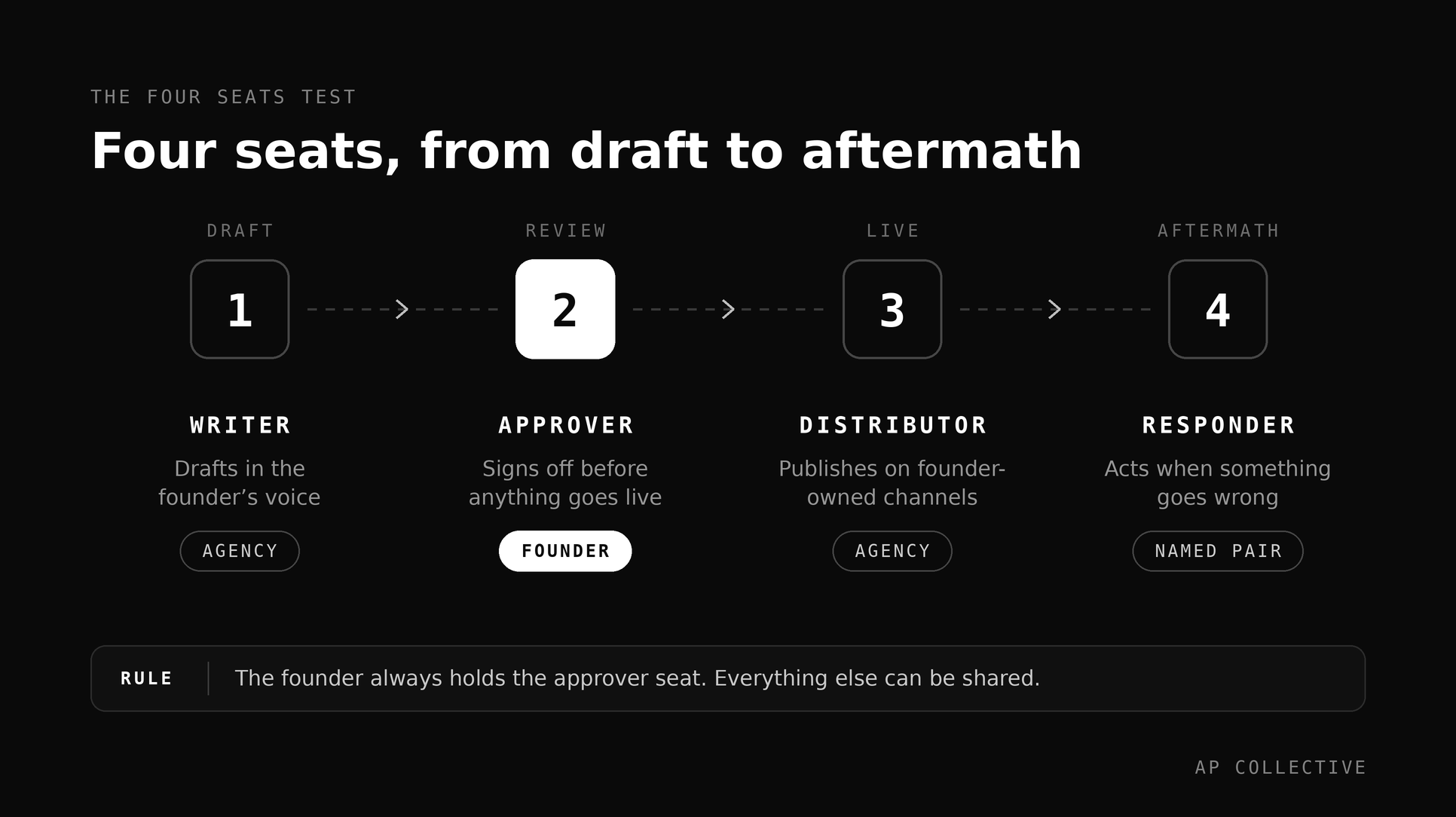
The test has one fixed rule. The founder always holds the approver seat, and the agency should refuse to publish without it. Everything else can be shared or delegated.
Need the seats mapped for your own project? Talk to AP Collective about {LINK: founder driven content and crypto PR} before you shortlist agencies.
Seat One: Who Writes in the Founder’s Voice?
The right writer drafts from the founder’s own recorded thinking, not from a brief, and a good agency can show you how it captures that thinking in the first 2 weeks. Ask for the method before you ask for samples.
Two features separate strong methods. The first is source material: weekly calls, voice notes or transcripts that the writer turns into drafts, so the opinions are the founder’s own. The second is a style document built from your past writing and updated monthly, which lets different writers produce consistent work.
Weak methods start from templates. If the agency’s sample posts could be swapped between two founders without anyone noticing, the process starts from the template and not from you.
AI changes the economics here and adds risk. Drafts are cheap now, so the writer’s job is judgement: cutting the safe line and keeping the specific one. Ask how the agency uses AI drafting, who edits the result, and whether your source material is ever entered into a public model.
Quality matters more than volume. Edelman and LinkedIn’s research found that 56% of decision-makers usually gain no valuable insight from thought leadership. Ten flat posts a month do more harm than four sharp ones.
Seat Two: Who Approves Before Anything Goes Live?
The founder approves everything that goes live, and anything touching price, token mechanics, listings, partnerships or regulation also needs a second reviewer with legal or compliance authority. Agree this in the contract, not in a chat thread.
Set an approval service level on both sides. A workable pattern is a 24-hour founder turnaround on routine posts and a 48 hour window for anything flagged sensitive, with the agency holding the content when the clock runs out rather than publishing. An agency that proposes auto publishing on timeout is optimising for its own output count.
Define the sensitive list in writing before the first draft. Forward-looking statements, performance claims, comparisons with named competitors and any mention of unreleased partnerships belong on it. Securities and promotion rules differ by jurisdiction, so have counsel review the list. We are not lawyers.
Keep an approval log, even a simple one: the draft, the approver, the time and the version that went live. When something goes wrong, the log is the first thing counsel and the founder will ask for.
Seat Three: Who Distributes the Founder’s Content?
Distribution should run through channels the founder owns, operated by the agency under delegated access, and it should cover at most 3 channels at first. Spread thinner and nothing gets enough attention.
Pick channels by audience. X remains the default for crypto native users and investors. LinkedIn reaches hires, enterprise partners and traditional-finance counterparts. Podcasts and long-form interviews reach people who will spend 30 minutes with your thinking, which is the closest thing to a due-diligence read. Earned media sits behind all three, because a journalist’s quote is a third-party signal that your own channels cannot produce.
Ask how access works. The founder should own the accounts, the agency should use scoped permissions or a management tool, and credentials should never be shared in a chat. If an agency insists on running content from its own accounts or asks for your password, treat that as a security issue and not a convenience.
Amplification is separate from distribution. Paid boosts and KOL pushes can extend a good post, but they cannot rescue a weak one, and bought engagement damages the credibility you are trying to build. Ask what share of reach is paid and how the agency labels it.
Seat Four: Who Answers When Something Goes Wrong?
Name a responder on each side, a pair of people who can act within 60 minutes when a fake account, a leak or a backlash appears. Most agencies sell the content and never mention this seat, which is why it is where you should press hardest.
The threat is real and growing. Chainalysis found that impersonation scams grew by roughly 1,400% in 2025, with the average payment rising more than 600%. Separately, AI-enabled scam operations were 4.5 times more profitable than traditional ones. A founder with a large following and hours of recorded video gives scammers the raw material for a convincing fake.
Here is the uncomfortable part. Building a recognisable founder brand makes you a better impersonation target. That is a real cost of the work, and an honest agency will say so and plan for it.
Ask for a written response plan. It should cover verified-account setup with a public list of official handles, a pinned post stating where you will and will not ask anyone for money, a takedown route for fake accounts on each platform, and a holding statement ready for backlash. Then run a 20-minute drill once, before you need it.
Unsure who would respond if a fake founder account appeared tomorrow? Ask AP Collective about {LINK: crypto community management} and a written response plan.
How Do You Score Agencies Against the Four Seats?
Score each agency from 1 to 5 on each seat, weight the approver and responder seats double, and reject any agency that scores below 3 on either of those two. The weighting reflects where the damage comes from.
Seat | Weight | What a 5 Looks Like | What a 1 Looks Like |
Writer | 1x | Documented capture method, style document, drafts built from founder source material | Templates and generic samples |
Approver | 2x | Written approval flow, sensitive-claims list, approval log, no auto-publish | Publishes on timeout or without sign-off |
Distributor | 1x | Founder-owned accounts, scoped access, labelled paid reach | Agency-owned accounts or shared passwords |
Responder | 2x | Named pair, written plan, takedown routes, drill completed | No plan and no named person |
The maximum score is 30. We would aim for 24 or above and treat anything under 18 as a pass. These thresholds are our judgement, not an industry standard, so adjust them to your risk appetite.
Use the table as the structure for discovery calls. Send the same questions in writing to every shortlisted firm so the answers are comparable, and score from the written answers rather than from how the call felt.
Which Deliverables Should You Compare?Compare deliverables by cadence, format and ownership, because two retainers with the same headline price can contain very different amounts of real work. Ask each agency to fill in the same table. Deliverable | What to Ask | Why It Matters | Posts and Threads | How many per month, and how many are original rather than recycled? | Volume without originality adds noise | Long-Form Pieces | How many articles, newsletters or op-eds per quarter, and who owns the byline? | Long-form reaches the due-diligence reader | Earned Media | How many pitches go out, and what counts as a placement? | Pitches sent and placements won are different numbers | Speaking and Podcasts | How many bookings are sourced, and who prepares the founder? | Preparation decides whether an appearance helps | Reporting | What is measured, how often and from which data? | Reports built on impressions alone hide results |
| |
| |
Cross-check against price. Our guide to {LINK: crypto marketing agency pricing} explains how retainers and fees are structured, and the same logic applies here. A low price attached to a long deliverables list usually means the deliverables are thin.
What Contract Terms Should You Insist On?
Insist on four terms: founder ownership of all accounts and content, a 30-day exit after the first quarter, written approval rights, and confidentiality over your source material. Most founder branding disputes trace back to one of these four being vague.
- Ownership. Accounts, drafts, audience lists and archives belong to the founder or the company, and transfer on request without a fee.
- Exit. A first term of 3 months gives the work time to show results, then 30 days’ notice. Longer lock-ins protect the agency more than they protect you.
- Approval. The approver seat from the test is written into the agreement, including the rule against auto-publishing.
- Confidentiality. Your calls, notes and unreleased plans are covered, and the agency states whether any of it is entered into third-party AI tools.
One more clause is worth asking for: a named lead on the account. When an agency swaps the person who knows your voice, the first thing you lose is the voice.
Which Metrics Show a Founder Brand Is Working?
Judge a founder brand over a 90-day window on inbound quality: investor, partner and candidate conversations that cite the founder’s content, plus how much of your name’s search results you control. Follower counts come last.
- Inbound conversations that cite your content. Ask every new contact how they heard of you and log the answer in one place.
- Search results for your name. Search it in a private window and count how many of the first 10 results you or your team control, and how many are accurate.
- Qualified traffic from founder links. Tag every link and follow clicks through to deposits using the ledger approach in our guide to {LINK: crypto marketing attribution}.
- Earned citations. Third-party quotes, podcast invitations and mentions by peers you respect.
Be honest about the limits. Founder branding works slowly, and its effect on a funnel is hard to isolate, because many conversations start in private chats that no tracker sees. Treat the numbers as evidence rather than proof, and compare quarter to quarter instead of week to week.
Want founder content tied to real conversations and funded accounts? Ask AP Collective about {LINK: crypto content marketing} with tracking built in from the first post.
What Red Flags Should You Look For in a Pitch?
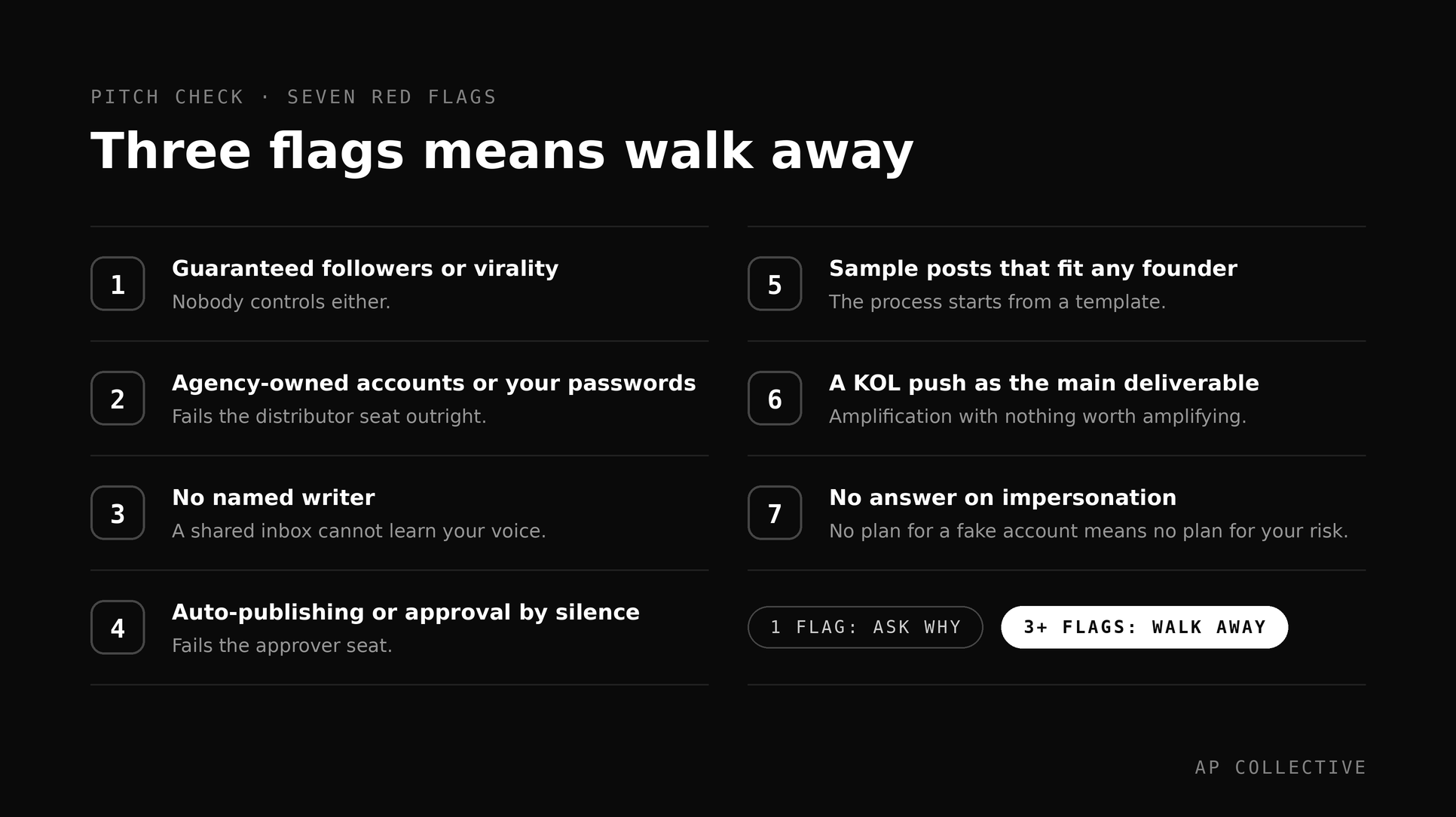
Treat these seven signals as red flags, and walk away from any agency showing 3 or more. Most are visible on the first call.
- Guaranteed follower counts or viral outcomes. Nobody controls either.
- Agency-owned accounts, or requests for your passwords. That fails the distributor seat outright.
- No named writer. A shared inbox cannot learn your voice.
- Auto-publishing or approval by silence. That fails the approver seat.
- Sample posts that could belong to any founder. The process starts from a template.
- A KOL push as the main deliverable. Amplification with no content worth amplifying wastes the budget.
- No answer on impersonation. If the agency has no plan for a fake account, it has not thought about your risk.
One flag alone is a question to ask. Three is a pattern.
How Do You Run a 30-Day Agency Comparison?
Run the comparison in four weeks: shortlist 3 agencies in week one, send identical written questions in week two, run a paid pilot with your top 2 in weeks three and four, and decide on evidence.
- Week 1, Prepare. Write down your 3 positions, pick your channels, and shortlist 3 agencies.
- Week 2, Question. Send the same written questions on the four seats to each firm, score the answers with the table above, and ask for sample contract terms.
- Weeks 3 and 4, Pilot. Pay your top 2 firms to produce 4 drafts each from the same founder call, run one full approval round and run one response drill.
- End of Week 4, Decide. Remove the agency names and ask your team which drafts sound like you. Pick the firm whose drafts they choose and whose process scored highest.
Budget for the pilot and be willing to pay for it. An agency that will not do a paid pilot is telling you something about how it expects the work to look.
How Does AI Change Founder Branding for Crypto CEOs?
AI makes drafts cheap and your voice easier to copy, so the value of an agency moves from producing text to protecting judgement and security. Both effects matter for crypto CEOs.
On the production side, anyone can generate a plausible founder post in seconds, which is why the quality bar has risen. Generic posts are now the default, and readers have learned to scroll past them. Specific opinions, named examples and real numbers are the things that still stand out.
On the security side, AI-enabled scam operations were 4.5 times more profitable than traditional ones, and cloning tools need less source material every year. Assume that any public recording of you can be used. Agree a code word with your team for any payment or access request that arrives by call or video, and tell your community that you will never message first about money.
Ask each agency for its AI policy in writing: which tools it uses, what founder material goes into them, who edits the output, and how it labels AI assistance where rules require.
How Does AP Collective Approach Founder Branding?
AP Collective’s position is that the founder holds the approver seat, always, and that everything else is designed around that rule. The Four Seats Test is the standard we apply to our own engagements, and our Raydium work is the founder-driven content program we can point to publicly.
For Raydium, we built a founder-led content funnel around the project’s technical founders, producing posts, videos and articles in one consistent voice. It ran alongside a rebuilt brand position and a creator network timed to product milestones, including the Launch Lab rollout. Across the engagement, the case study reports +50% Solana DEX market share, 70M+ impressions, 3.5M+ KOL reach and 105K+ new followers, while Launch Lab moved $7B+ in cumulative volume.
Those results belong to the whole program. The case study does not break out the founder content on its own, so read it as an example of how the model works and not as proof of what founder content alone produced.
This kind of work sits under our Founder Funnel service, which turns founder presence into a distribution channel.
One inconvenient fact. If you cannot give an agency 2 hours a week and 3 real positions, we would rather you wait than pay us for generic content.
Comparing agencies right now?
Book a call with AP Collective about brand positioning for a founder-led launch and bring your scorecard.
Frequently Asked Questions
What does a founder personal branding agency do for a crypto CEO?
It turns the founder’s ideas into a public presence through writing, social posting, speaking, earned media and community engagement. The best ones also manage approvals, access and incident response. The work covers writing, distribution and risk, so judge an agency on all three and not only on how its posts read.
How much should a crypto CEO budget for personal branding?
There is no universal figure, because scope varies from a few posts a week to a full media and speaking program. Compare deliverables on a like-for-like table first, then compare prices. Our guide to {LINK: crypto marketing agency pricing} explains how retainers are built, and a paid pilot is a cheaper test than a long contract.
Should a crypto founder write their own content?
Often yes, at the start. Posting yourself for a month shows you what your voice sounds like and which positions you hold. Hire help when you have a product, a team and a clear point of view but not the time to produce and distribute content consistently.
How long does a founder brand take to show results?
Expect early signals within 90 days, such as more inbound conversations that cite your content. Compounding effects usually need longer, and we would plan for a year. Founder branding rewards consistency, so judge it quarter by quarter rather than post by post.
What is the difference between founder branding and company branding?
Company branding builds recognition for the project. Founder branding builds trust in the person accountable for it. In crypto the two are linked, because users and investors often judge the project by the person. Founder branding carries more personal and security risk, which is why the approver and responder seats matter.
Can an agency post on my behalf?
Yes, under delegated access and a written approval flow. The founder should own the accounts, the agency should use scoped permissions or a management tool, and nothing should publish without the founder’s sign-off. Never share passwords, and ask for the agency’s approval log if a post causes trouble.
How do you protect a crypto founder from impersonation?
Set up verified accounts, publish a list of official handles, pin a post stating that you will never ask for money in messages, and keep a takedown route for each platform. Chainalysis found that impersonation scams grew roughly 1,400% in 2025, so write the response plan before you need it.
What should a founder branding agency report?
It should report inbound conversations that cite your content, search results for your name, qualified traffic from tagged founder links, and earned citations. Impressions and follower counts can appear as context, but they should not be the headline. Ask for the data source behind every number.
Is founder led marketing worth it for a small crypto project?
It can be, if the founder has real positions and about 2 hours a week. A small project often has more to gain, because the founder is the most credible asset it has. It is not worth it if the product does not exist yet or the founder cannot approve content in time.
How do I compare founder branding agencies?
Use the Four Seats Test. Send the same written questions on the writer, approver, distributor and responder seats to each shortlisted firm, score the answers from 1 to 5 with the approver and responder seats weighted double, then run a paid pilot with your top 2.
Final Takeaway
A founder who hires on follower promises will get followers. A founder who hires on the four seats will get control. The first mistake usually shows up as a post nobody approved or a fake account nobody answered, in the same week your name is most visible. The second takes a few hours of written questions before you sign.
The One-Page Action SpineStep | Action | Owner | Done When | 1 | Write down 3 positions you hold and could defend | Founder | Written and shared with marketing | 2 | Pick up to 3 channels and confirm account ownership | Founder and marketing | Accounts verified and owned by you | 3 | Send the four-seat questions to 3 shortlisted agencies | Marketing | Written answers received | 4 | Score answers with the table, approver and responder double | Founder and marketing | Every agency scored out of 30 | 5 | Agree the sensitive-claims list with counsel | Founder and legal | List signed off before the first draft | 6 | Run a paid pilot with the top 2 agencies | Marketing | 4 drafts, 1 approval round and 1 drill each | 7 | Sign with ownership, exit, approval and confidentiality terms | Founder | Contract includes all four |
| |
| |
Reviewed periodically. If you spot something outdated, write to info@apcollective.io