Founder Personal Branding Agencies for Crypto CEOs: How to Compare Them
How to compare founder personal branding agencies for crypto CEOs, using a four seat test for who writes, approves, distributes and responds to a crisis.
Read article

Written by
Abhi
Founder & CEO
Published October 27, 2026
How to acquire wallet users, get them to a first action, and bring them back, with the metrics and incentives that matter at each stage.
Roughly 68% of people who connect a wallet to a DeFi app never complete a first action, according to Formo’s 2026 onboarding analysis. The click was never the hard part.
That number should change how you spend a wallet marketing budget. Most teams still buy installs, count them as wins, and wonder why the monthly active line stays flat. A wallet is the front door to crypto, and a front door only matters if people walk through it a second time.
Wallet marketing is a funnel with five moments, not a single acquisition problem. Each one fails for a different reason and needs different work.
Marketing a wallet is harder than marketing most crypto products because users hand it custody of their assets before it has earned any trust, and it delivers no value until they do something else with it. The market is big and crowded. Datawallet projects the global crypto wallet market growing from $19.3B in 2026 to $100.8B by 2033, and reports MetaMask at roughly 30M monthly active users and Phantom peaking near 17M in 2025 (Datawallet’s 2026 wallet statistics).
Three things make wallets different:
User counts also mislead. Figures for Trust Wallet range from about 17M monthly users to 60M and 220M total users depending on the source, because some sources count monthly actives and others count cumulative registrations. Do not benchmark yourself against a number until you know which one it is.
The Five-Moment Wallet Map is AP Collective’s way of splitting wallet growth into five stages, each with its own question, metric and failure mode: Reach, Create, Fund, Act and Return.
Moment | The Question | What to Track | Common Failure |
Reach | Do the right people know you exist? | Qualified visits and install rate | Buying volume from users who never open the app |
Create | Can they set up in minutes? | Wallet creation rate and time to create | A recovery-phrase flow that scares people off |
Fund | Do they put assets in? | Funded-wallet rate | No simple on-ramp inside the app |
Act | Do they do something useful? | First-action rate and time to first action | A blank screen after connecting |
Return | Do they come back? | Day 7 and day 30 return | One transaction, then silence |
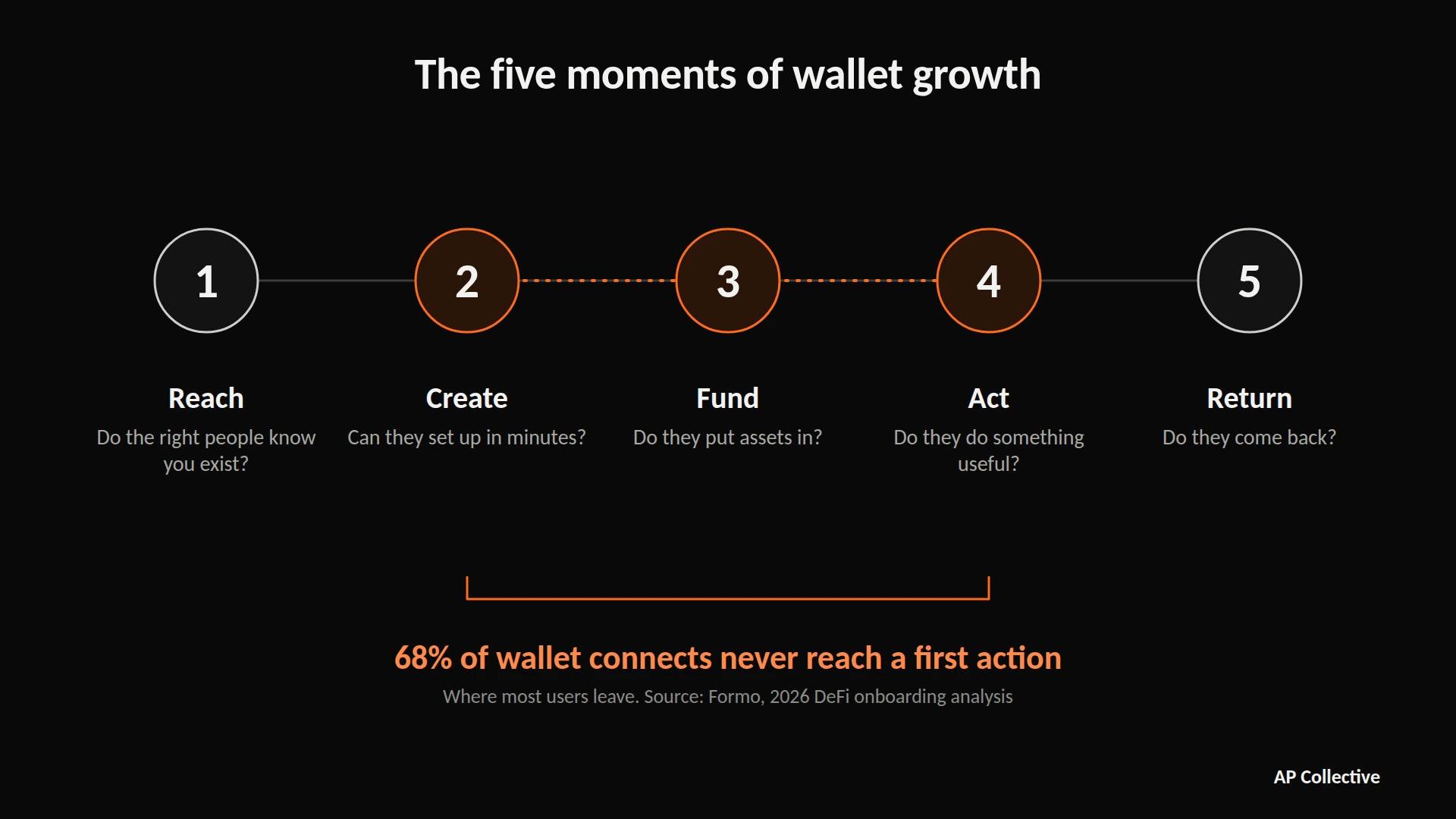
Most teams measure only Reach and Create, because those are the numbers an ad dashboard hands you. The money is lost in Fund and Act. Formo’s analysis puts the connect to first activation rate in DeFi at 32%, which means 68% of the people you worked to attract leave between Create and Act.
We use the map to decide where to spend before we decide how much. If Create is leaking, more Reach just makes the leak more expensive.
The channels that work for wallets are the ones that deliver intent: creators who show a real use case, chain and app partnerships that put your wallet at the point of need, search that answers best-wallet questions, communities where people ask for recommendations, and exchange or ecosystem placements. Five channels, one rule: intent beats volume.
We would rather see a team run two of these well than five badly. Pick the two closest to your chain and your user, and measure them on Fund and Act, not on installs.
If your wallet is launching or relaunching, AP Collective can map user acquisition, creators and community into one plan before spend gets split across disconnected tactics. See our user acquisition service or talk to the team.
Get users to create and fund a wallet by removing every decision that is not needed before their first action, and by putting a way to add funds inside the same flow. Across studies, 60% to 90% of new users leave before their first transaction, as The Block reported on wallet UX.
The cause is rarely distrust of crypto. It is the weight of irreversible choices made too early: saving a recovery phrase, picking a network, understanding fees. Each one is reasonable. Stacked before the user has seen any value, they add up to a reason to close the tab.
What we would change first:
This is mostly a product job, and marketing cannot fix a broken flow with better ads. What marketing can do is send the right people, set honest expectations in the ad, and measure where users stop.
Most wallet users never make a second move because the first transaction rarely teaches them why to come back. In the Dune Wallet Report v2, as summarised by Formo, 70% of Web3 wallet users make just one transaction and leave.
The gap between wallets is large. ND Labs’ summary of the same report compares two wallets:
Metric | Binance Web3 Wallet | Uniswap Wallet |
Users returning after 1 day | About 24% | About 40% |
Users returning after 7 days | About 13% | About 30% |
Average actions in the first 7 days | 1.1 | 3.8 |
In-app quests | None | Active |
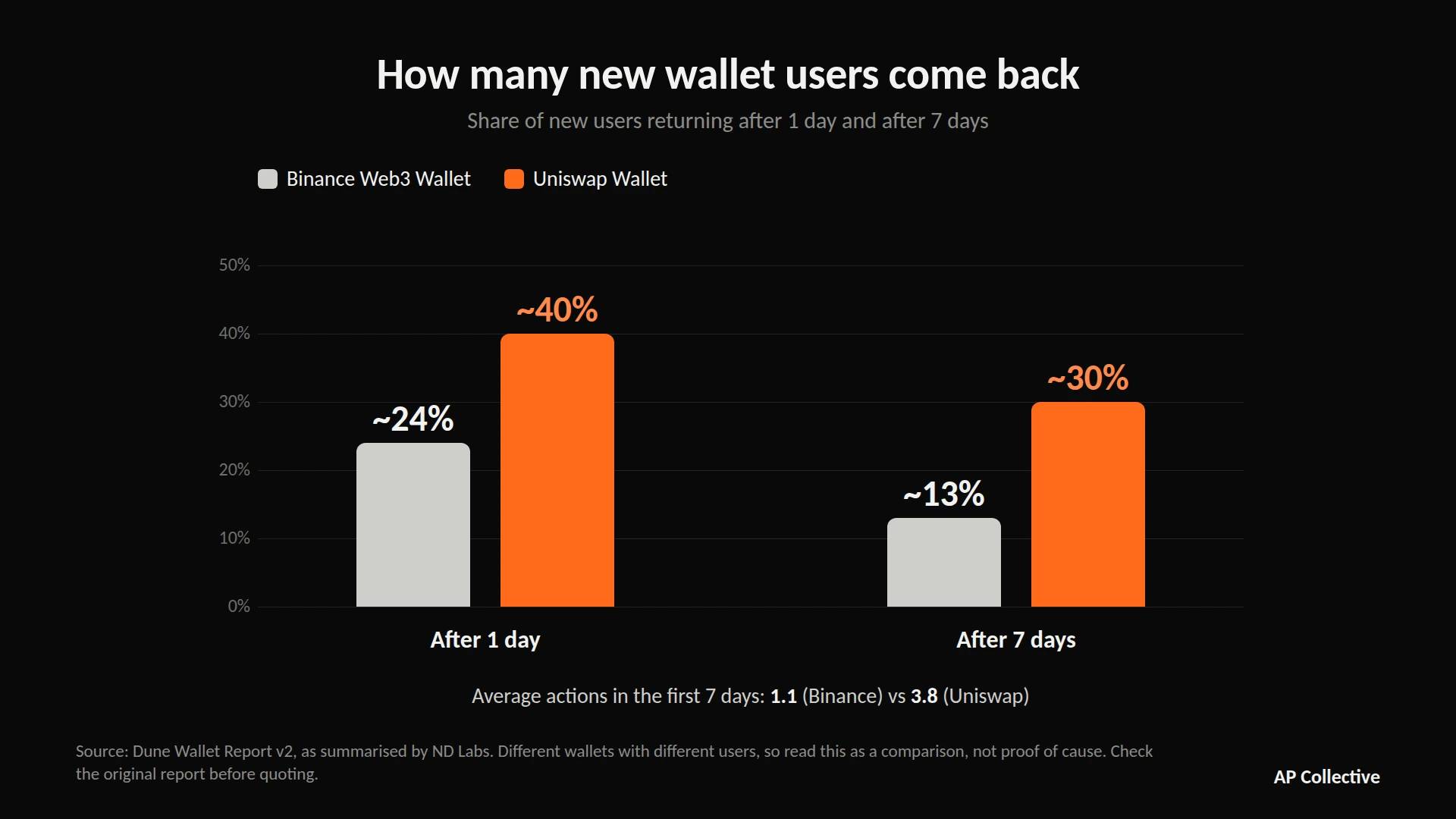
Two cautions apply. These are different wallets with different users, so the table does not prove that quests cause the gap. And the figures are secondary summaries, so check the original report before you quote them.
The pattern is still useful. The wallet whose users took more actions in week one kept more of them in week two. That points to a simple target: get a second action inside seven days, and design everything before it to make that second action easy.
Design a first action that sticks by choosing one action, pre-filling it, showing the result immediately, and then offering a second one. The goal is not a successful first transaction. It is a user who understands what the wallet is for.
Pick the action that matches your product. For a multichain wallet it may be a small swap. For a wallet tied to an ecosystem it may be claiming or sending a token. For a payments-focused wallet it may be a first card or transfer. Whatever you choose, apply the same four rules:
Time matters as much as design. Aim for minutes between creating a wallet and completing a first action, not hours or days. We do not have a published benchmark for the ideal figure, so set your own baseline first and improve it every month. Our guide to crypto marketing attribution covers how to track the steps in between.
Pay for second actions, not installs. An install tells you someone tapped a button. A second action tells you someone found a reason to come back.
Here is why the choice matters. Take an illustrative case, not a client example. Channel A delivers installs at $4 each, and 5% make a second action, so each second action costs $80. Channel B delivers installs at $15 each, and 30% make a second action, so each second action costs $50. The channel that looks four times more expensive per install is cheaper where it counts.
Most buyer advice says to minimise cost per install. We think that is backward for wallets, where 70% of users do one thing and leave. Optimising install cost buys more of the users who leave.
There is a catch. Second actions can be gamed. A wallet that pays for any action will attract people who do the cheapest one, repeatedly. Define a qualifying second action tightly: a different type of action, above a minimum size, on a different day. And do not trust an agency that reports installs as its headline number.
Running creator campaigns for a wallet launch? AP Collective’s influencer marketing team briefs and reports on creators by what users do after the click. Ask for a scoped quote.
Points and rewards programs can lift wallet activity, but only when they reward repeat behaviour and not raw volume. MetaMask is the largest example. Its Rewards program ran Season 1 from October 2025 to January 2026 and distributed over $30M in LINEA tokens, with points earned for swaps, bridging and referrals, according to MetaMask’s public record.
Program design decides the result. The same announcement drew criticism from some users, as The Block noted, which is a reminder that a rewards program is also a public statement about who you want as a user.
Incentive Type | Best For | Main Risk | Better Design |
Points per trading volume | Active traders | Wash trading and farmers | Cap per user and weight repeat days |
Referral rewards | Spreading through networks | Fake accounts | Pay out on the referred user’s second action |
Fee discounts | Repeat users | Weak pull for new users | Tier by tenure, not just volume |
Rewards for past use | Loyal users | A one-time spike | Tie future rewards to ongoing activity |
We advise against paying for raw volume. It is easy to measure and easy to fake, and it attracts people who leave the day the rewards end. If you run a program, track what happens in the 30 days after each season closes. That number tells you who you actually acquired.
Market wallet security by showing proof, not by making promises. Five trust signals do most of the work:
Avoid absolute claims such as unhackable or risk-free. Users have heard them before, and they read as the first sign that something is being hidden. A calm, specific statement of what you protect and what you do not beats a loud promise.
Place security messaging next to the action it relates to, not only on the homepage. A short note beside the recovery-phrase step does more than a security page nobody opens.
Retain wallet users by giving them reasons to return that are built into the product: new utility, timely prompts tied to their own assets, and rewards that run in seasons. Utility has the clearest evidence behind it. Phantom added in-wallet perpetual futures in July 2025, and one 2026 review reports more than $20.6M in cumulative builder fees from about $39B in perp volume and 137,000+ traders, as Pump Parade’s Phantom review lays out.
Cards and stablecoins follow the same logic. Datawallet notes that Phantom rolled its linked debit card out to all users in spring 2026, and MetaMask launched the MetaMask Card in February 2026. A wallet that handles spending gives users a reason to open it every week, not only when they trade.
Four retention levers are worth testing in order:
Utility beats messaging. If the product gives people no reason to return, no campaign will invent one.
Measure wallet growth with five metrics that follow the Five Moment Wallet Map, and track each by cohort and by channel.
Metric | How to Calculate | Why It Matters |
Connect-to-first-action rate | First actions divided by wallet connects | Shows onboarding quality. One 2026 analysis reports 32% for DeFi |
Time to first action | Median minutes from wallet creation to first action | Shows friction you can fix |
Funded-wallet rate | Wallets holding assets divided by wallets created | Shows whether Fund is working |
Day 7 and day 30 return | Share of a cohort active again | Shows retention without hiding behind totals |
Cost per second action | Spend divided by users making a qualifying second action | Compares channels fairly |
Totals hide the story. A rising user count can sit on top of falling cohort retention. Always read cohorts: everyone who joined in a given week, followed forward.
Track by channel as well, so you can see which source sends users who fund and return. Our guide to crypto marketing attribution covers how to connect clicks to first actions and beyond.
Need coverage and community moving together around a wallet launch? AP Collective runs community growth and social media marketing as one system, with named deliverables on every line. Start with a scoping call.
Run wallet growth region by region, because trust, payment rails and preferred channels differ by market. AP Collective’s published team coverage spans seven regions: North America, Europe, China, Korea, Japan, Türkiye and Southeast Asia. That spread exists because a campaign that works in one market often fails in the next.
Mobile-first users in emerging markets often choose wallets differently from desktop-first users in established ones. A wallet that wins on browser-extension convenience in one region may need a mobile-first, low-fee story in another.
Localise the parts users actually touch:
Check availability before you spend. App-store rules and local regulation can limit where a wallet can be distributed or what it can offer, and those rules change. Confirm the current position in each market with counsel, and plan campaigns around it.
Hire an agency when you have a live product, a defined first action and the budget to test several channels at once. An in-house team is better when your needs are steady and sit in one channel. Our in-house versus agency comparison works through the trade-offs, and our crypto marketing budget guide covers how to size the spend.
Here is the inconvenient part. If your onboarding leaks, hire a product designer before you hire an agency. Marketing can send better people to the door, but it cannot make a confusing door easy to open. A team of 60+ specialists, like ours, helps most when the product is ready to receive users.
What an agency adds is speed and breadth: creators, community, PR and regional execution at once, with someone senior watching the funnel. What it cannot add is product fixes or user trust you have not yet earned.
Ask these eight questions before you sign, and treat vague answers as answers.
An agency that leads with install volume is selling the number that hides the problem.
AP Collective treats a wallet launch as one system across reach, creators, community and measurement, and we scope it on the Five-Moment Wallet Map. We ask where users are leaking before we ask where to buy more traffic.
The record behind our approach: 600+ campaigns delivered, 100M+ users reached, 60+ specialists, and teams across seven regions. Our MEXC work drew 2.6M+ KOL impressions through 380+ creators, laid out in the MEXC case study.
We have a clear limit. We are a marketing partner, not a product team. If onboarding is your bottleneck, we will say so, because no amount of traffic fixes it. Wallet work also suits teams with a live product better than pre-product concepts.
AP Collective builds full-stack crypto growth systems across strategy, creators, PR, community, content, partnerships and regional execution. See every service or book a strategy call.
How much does it cost to market a crypto wallet?
It depends on your chain, regions and launch stage, and we do not have a published benchmark. Budget by moment: fund fixes to Create and Fund before you buy more Reach. Our crypto marketing budget guide covers how to size spend.
What is a good wallet activation rate?
One 2026 analysis puts connect-to-first-activation at 32% for DeFi wallets. Treat that as a reference point, not a target. Measure your own baseline and improve it every month.
Which channel is best for wallet growth?
The one that delivers intent at the lowest cost per second action. For most wallets that means creators who show a real task and partnerships inside dApps, before broad paid reach.
How do you reduce wallet onboarding drop-off?
Cut steps from Create, put an on-ramp inside the flow, and show one clear first action. Then track time to first action and step level drop off.
Do airdrops and points programs work for wallets?
They can lift activity, but only if rewards follow repeat behaviour. Paying for raw volume attracts farmers who leave when rewards end. Track the 30 days after each season.
How do you measure wallet retention?
Use cohort based day 7 and day 30 return, plus the share of users making a qualifying second action. Review the numbers by channel.
Should a wallet launch its own token?
A token is a separate decision with its own risks, and it does not fix weak onboarding. MetaMask has said it plans a token, and it ran a rewards program and shipped product utility first.
How do you market wallet security?
Show proof: named audits, a clear recovery explanation, an incident record and named people. Avoid absolute claims such as unhackable.
How long does wallet growth take to show results?
Plan on 90 days to see funnel movement by cohort. Fixes to Create and Act can show up in weeks, while retention needs at least a month of cohort data.
Should I hire an agency to market my wallet?
Hire one when you have a live product, a defined first action and budget to test channels. If onboarding leaks, fix the product first.
A wallet is not won at the install. It is won when a user does something useful, then does it again. Fix the biggest leak between Create and Act, pay for second actions, and design rewards that outlast the campaign.
Keep Reading
How to compare founder personal branding agencies for crypto CEOs, using a four seat test for who writes, approves, distributes and responds to a crisis.
Crypto marketing attribution helps teams track the full journey from clicks and sign ups to deposits and first trades. Learn how to measure KOL performance, identify which campaigns bring real traders, and make smarter marketing budget decisions.
Why ChatGPT and Google's AI answers cite Reddit, what changed in August and September 2026 and how crypto teams can audit the threads that shape them.
WHAT'S NEXT
Book a call with the team. No pitch deck required.