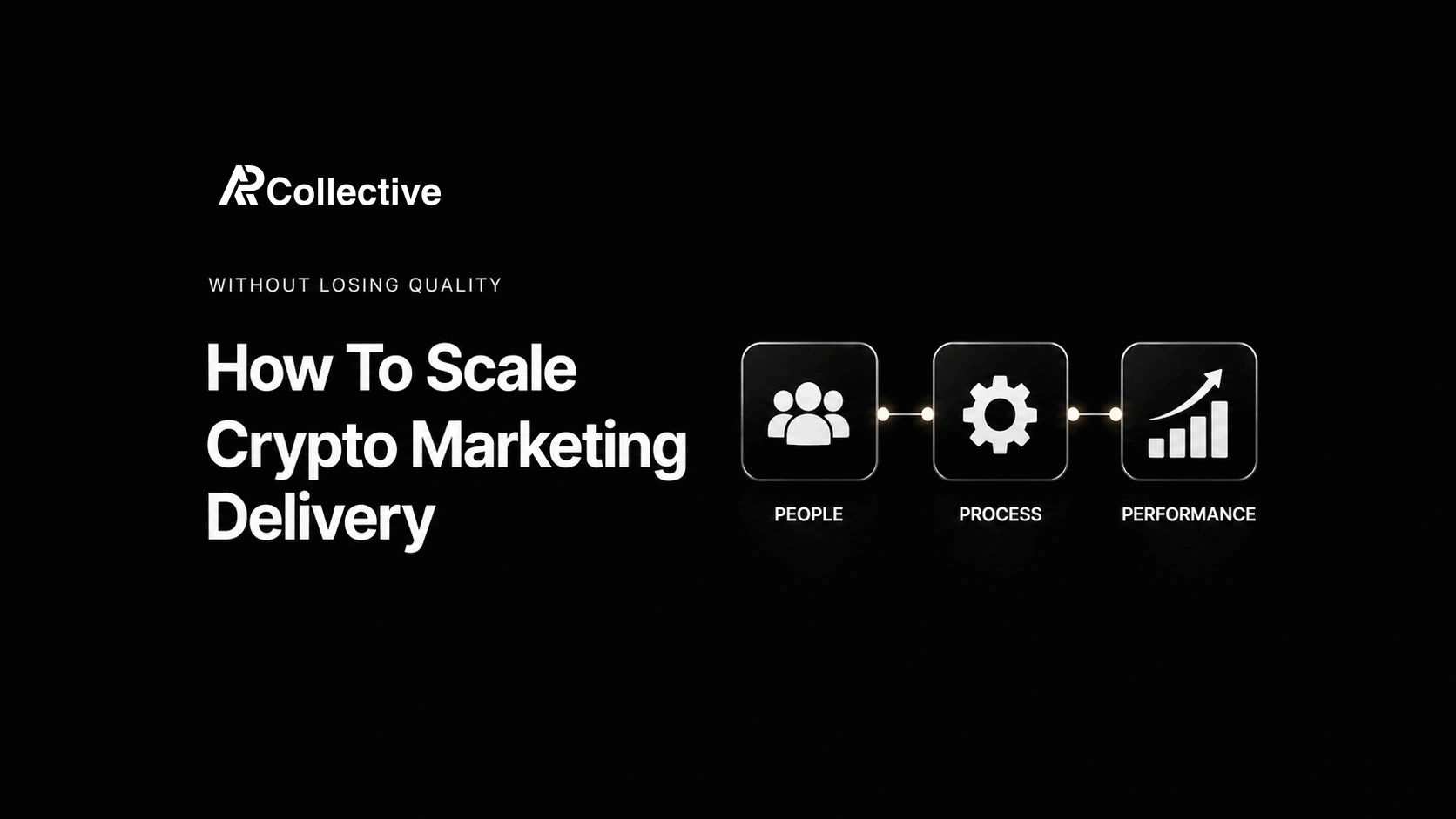
Delivery Without Losing Quality?
An operations playbook from AP Collective, updated July 2026
Scaling is where most agencies quietly break.
The work is good at five clients. The team is close, everyone knows every campaign, quality is high because someone senior touches everything. Then it is fifteen clients, and the same team is drowning. Deadlines slip. A post goes out off-brand. The senior people who used to catch everything are now the bottleneck for everything.
The instinct is to hire faster. That usually makes it worse.
The real answer is that quality at scale is not a talent problem. It is a systems problem. I run operations at AP Collective, where the team delivers across 600+ campaigns and a network of 5,000+ creators. This is how you grow volume without watching quality fall out the bottom. It builds on the delivery systems we mapped in how crypto marketing agencies actually deliver.
Growing faster than your systems can handle? Get a free ops audit, and we will show you where quality is about to slip.
Table of Contents
- The 4 Levers of Quality at Scale
- The Order to Build the Levers
- Why Does Quality Break When You Scale?
- What Breaks First, and in What Order
- Systemize the Repeatable, Reserve Judgment for the Exceptional
- Build Quality Gates, Not Quality Heroes
- Plan Capacity Before You Sell It
- The Capacity Math, in Practice
- Use a POD Model so Quality Does Not Dilute
- Let Tooling Carry the Load
- How to Measure Delivery Quality at Scale
- Common Scaling Mistakes
- Scaling In-House vs With an Agency
- What Good Scaled Delivery Feels Like
- Signs Your Delivery Is About to Break
- FAQs
Key Takeaways
- Quality that depends on one senior person touching everything does not scale. It caps.
- Scale on four levers: Systems, Gates, Pods, and Tools, with capacity planning as the governor.
- Systemize the repeatable, reserve human judgment for the exceptional. That is the whole game.
- Quality gates beat quality heroes. Build checkpoints into the workflow instead of relying on someone to catch problems.
- Capacity planning is not optional. If you scale client count without scaling capacity math, quality collapses on schedule.
- The goal is a delivery system where the floor is high even on a bad week, not one where the ceiling is high on a good one.
The 4 Levers of Quality at Scale
Before the detail, here is the model the rest of this playbook hangs on. We scale delivery on four levers, held in check by one governor. Name them, and you always know which one to pull when quality starts to wobble.
Systems. Push every repeatable task into a defined workflow, so it does not depend on anyone remembering how it is done. Systems turn heroics into routine.
Gates. Build quality checkpoints into the workflow itself, so nothing ships without clearing defined checks. Gates make quality a property of the process, not of one reviewer.
Pods. Organize delivery into small, cross-functional teams that own a set of clients end-to-end. Pods concentrate ownership so quality does not dilute as you add clients.
Tools. Automate the high-volume, error-prone work that humans should not be doing by hand. Tools keep the error rate flat while the volume climbs.
The governor: capacity planning. None of the four levers matter if you sell more than you can deliver. Capacity planning is the discipline that decides when to add a pod, when to hire, and when to pause intake. It governs the whole system.
Every section below is one of these 5 ideas in detail. If quality is slipping in your delivery right now, one of these 5 is the lever that is not being pulled.
 The 4 levers of quality at scale: systems, gates, pods, tools, plus capacity
Not sure which lever is your weak spot? Get your free proposal, and we will tell you where to start.
The Order to Build the Levers
You do not build all four levers at once. There is a sequence, and getting it right saves you from fixing the same problem twice.
Start with systems. Until the repeatable work is written down as a defined workflow, everything else is built on sand. Templates for briefs, content, and reporting are the cheapest, highest-return first move.
Add gates next. Once the workflow exists, put the quality checkpoints into it. Gates are almost free to add on top of a documented system, and they immediately stop the most damaging errors from reaching clients.
Then move to pods. When you have systems and gates, you can replicate them. A pod is just a small team running the same documented, gated workflow, which is why pods only work well once the first two levers exist. Add a pod before you have systems and you have simply cloned the chaos.
Tool last, but tool deliberately. Automate the highest-volume, most error-prone tasks first, usually creator operations and payments. Tooling built on top of a clear workflow pays for itself. Tooling built to paper over a broken process just automates the mess.
Capacity planning runs the whole time, because it governs when you are allowed to grow at all. Build in this order and each lever reinforces the last. Build out of order and you spend money fixing foundations you skipped.
Why Does Quality Break When You Scale?
At small volume, quality is invisible infrastructure. It works because a few experienced people can hold the whole operation in their heads.
That model has a hard ceiling. Human attention does not scale linearly, and the founder or senior lead who reviews every deliverable becomes the single point of failure the moment volume rises. Add clients and you are not adding capacity. You are adding load to a person who was already at their limit.
The stakes are not abstract. In a market where more than half of tokens launched since 2021 have gone inactive, per CoinGecko data via CoinDesk, a client cannot afford to be the campaign that slipped through the cracks because the agency grew faster than its systems. Every dropped deliverable is a client wondering if they are next.
So the question is not "how do we work harder." It is "how do we make quality a property of the system instead of a property of a person."
Recognize your team in that description? Book a free 30-minute call and we will map the fix.
What Breaks First, and in What Order
Scaling failure is not random. It happens in a predictable order, and knowing the sequence lets you get ahead of it.
First, senior review becomes the bottleneck. The person who checked everything cannot keep up, so either they become the blocker on every deliverable or they start waving work through unchecked. Both hurt.
Second, consistency drifts. Without a shared system, two pods do the same task two different ways, and the client feels it as an uneven experience.
Third, the small errors arrive. An off-brand post, a wrong figure, a missed deadline. Individually minor, collectively the signal that the operation is past its limit.
Fourth, retention slips. The unglamorous post-launch work is the first thing to fall off when a team is underwater, so communities go quiet right when they should be compounding.
By the time a client complains, the break started three steps earlier. The whole point of building systems, gates, pods, and tools before you need them is to interrupt this sequence at step one, not step four.
Systemize the Repeatable, Reserve Judgment for the Exceptional
Almost everything an agency does falls into two buckets.
The first is repeatable work. Brief formats, content review steps, reporting structures, creator onboarding, payment processing. This work benefits from standardization. Every time you do it as a one-off, you pay for it again.
The second is exceptional work. Narrative strategy, a novel campaign concept, a delicate client conversation, a creative judgment call. This work needs human judgment and does not compress into a template.
The mistake most teams make is spending their scarce senior attention on the repeatable bucket. They review routine posts by hand while the strategic thinking that only they can do waits. Scaling well means pushing the repeatable into systems so human judgment is freed for the work that actually needs it.
Work Type | Examples | How to Scale It |
Repeatable | Briefs, content QA, reports, creator onboarding, payments | Templates, checklists, defined workflows, tooling |
Exceptional | Narrative, campaign concepts, sensitive calls, judgment | Protect senior time for it, do not automate it |
The test is simple. If a task will be done more than a handful of times, it deserves a system. If it needs a human to weigh tradeoffs that a checklist cannot capture, protect the time for it. Most quality problems at scale come from getting this backwards: automating the judgment and hand-cranking the routine.
Build Quality Gates, Not Quality Heroes
A quality hero is one person who catches problems before they ship. It feels great until that person is on a flight, or overloaded, or gone.
A quality gate is a checkpoint built into the workflow that does not depend on any single person being heroic. Work does not advance to the next stage until it clears the gate. The standard lives in the process, not in someone's memory.
For crypto content, a practical gate sequence looks like this.
Gate | What It Checks | Who Owns It |
Brief check | Does the brief match the strategy and narrative | Account lead |
Accuracy check | Facts, figures, token details, dates correct | Reviewer or strategist |
Compliance check | No claims that create legal or regulatory risk | Compliance owner |
Brand check | Voice, positioning, and visual consistency | Brand owner |
Regional check | Message lands correctly per language and region | Regional lead |
The point is not bureaucracy. The point is that a compliance error or an off-brand post gets caught by the gate every time, not only when the right person happens to be looking. Gates make the floor high. Heroes only make the ceiling high on their good days. In crypto specifically, the compliance gate is not optional, because a careless claim is not just off-brand; it is a legal risk that can follow a project for years.
 The 5 quality gates every piece of work clears before it ships
Want a gate system like this built into your workflow? Get a free delivery audit and we will design it with you.
Plan Capacity Before You Sell It
Most quality collapses are really capacity collapses wearing a costume.
An agency sells three new clients in a month without doing the math on whether it has the delivery capacity to serve them at standard. The work gets sold, the calendar fills, and quality drops because the team is now structurally over-capacity. This was predictable. Nobody predicted it.
Capacity planning is the unglamorous discipline that prevents this. Before taking on load, you map it.
Input | Question to Answer |
Demand | How many campaigns and deliverables does this client add per month |
Capacity | How much can each pod or specialist deliver at standard |
Buffer | What slack remains for launch surges and surprises |
Trigger | At what utilization do we hire or pause new intake |
The trigger line matters most. A team running at 100% utilization has no capacity to absorb a launch week or a client crisis, and both are certain to come. Healthy operations run with deliberate buffer and treat the moment utilization crosses the trigger as the signal to add capacity, not the moment everything is already on fire.
The Capacity Math, in Practice
Capacity planning sounds abstract until you put numbers on it, so here is a simplified version of how we think about it.
Say a pod can deliver the equivalent of four active clients at standard quality, with a deliberate buffer that keeps it at around 80 percent utilization for normal weeks. That buffer is not slack for its own sake. It is what absorbs a launch week, where one client temporarily needs the attention of two.
Now you sign a fifth client for that pod. On paper the pod is at 100 percent. In practice it is over, because the buffer is gone and the first launch surge will push it past its limit. The quality drop is not a maybe. It is scheduled for the next busy week.
The fix is to treat the trigger as a hard line. When a pod crosses it, you either add capacity by standing up or growing a pod, or you pause new intake for that pod until capacity catches up. The mistake almost everyone makes is selling first and solving capacity later. By then the quality has already slipped, and a client has already noticed.
This is why capacity planning is the governor on the whole system. The systems, gates, pods, and tools all assume the team is not structurally underwater. Break that assumption and every other lever fails with it.
Want the capacity math run against your actual client load? Book a free call and we will model it together.
Use a POD Model so Quality Does Not Dilute
One large team serving many clients dilutes attention. Everyone is a little responsible for everything, which means nobody is fully responsible for anything.
A pod model fixes this. Small, cross-functional teams own a defined set of clients end-to-end. The pod knows its clients deeply, owns their quality, and carries clear accountability. When you need more capacity, you add a pod with the same operating standard rather than stretching an existing team past its limit.
This is why we embed specialists directly with founding teams rather than running a shared pool billing from the sidelines. Ownership concentrates quality. Dilution spreads it thin. You can see the difference in the depth of our case studies, where the same team stays close to a project across its whole growth arc.
The pod model also fixes the onboarding problem that comes with growth. A new client dropped into a shared pool gets whoever is free. A new client assigned to a pod gets a team that owns the relationship from day one, which is exactly the clean start we describe in the crypto client onboarding playbook.
There is work that humans should never be doing manually at scale, and creator operations is full of it.
Matching thousands of creators by region and audience, screening for follower authenticity, tracking deliverables across a launch, processing payments accurately: doing any of that by hand does not just slow you down. It introduces errors that damage quality directly. A fake follower account that slips through is wasted budget. A missed payment is a creator who stops answering.
This is why we built 50+ tools in-house and run the largest distribution network in Web3 on top of them. Not for the slide, but because the alternative is quality that degrades every time volume rises. Tooling is how you keep the error rate flat while the volume climbs.
The rule of thumb: if a task is high-volume, repetitive, and punishing when done wrong, it belongs to a tool, not a person. Humans are for judgment. Tools are for scale. Confuse the two, and you either burn out your people or ship errors, usually both.
How to Measure Delivery Quality at Scale
You cannot protect what you do not measure. Once you are past a handful of clients, quality has to be tracked as a number, not felt as a vibe. These are the signals we watch.
Metric | What It Tells You | Healthy Direction |
On-time delivery rate | Whether capacity matches load | High and steady |
Rework rate | How often work fails a gate | Low and falling |
Utilization per pod | Whether a pod is over or under capacity | Around 80 percent |
Client retention | Whether quality is holding over time | High |
Post-launch engagement | Whether the unglamorous work is happening | Sustained, not spiking |
The two most revealing numbers are rework rate and utilization. A rising rework rate means the gates are catching problems, which is good, but also that something upstream is producing them, which is worth fixing. A pod stuck at 100 percent utilization is a quality collapse with a countdown on it. Watch those two and you will see trouble weeks before a client does.
None of this needs expensive software. A shared dashboard the whole team can see is enough. What matters is that quality stops being invisible, because invisible quality is the kind that slips.
Seems useful? Try it out and we will help you stand up a delivery quality scorecard.
The Scaling Checklist
Use this to pressure-test whether your delivery can actually handle more load.
Step | What to Do | Why It Matters |
Separate the work | Split repeatable from exceptional work | You cannot systemize what you have not sorted |
Build gates | Put quality checkpoints into the workflow | Quality survives when heroes are unavailable |
Template the repeatable | Standardize briefs, content, and reporting | Consistency and speed rise together |
Do the capacity math | Map demand against real delivery capacity | Prevents selling more than you can deliver |
Set the trigger | Define the utilization point to hire or pause | Turns scaling into a decision, not a crisis |
Adopt pods | Give small teams end-to-end ownership | Ownership concentrates quality |
Tool the manual work | Automate creator ops, tracking, payments | Keeps error rate flat as volume grows |
Common Scaling Mistakes
The ways agencies break under growth are remarkably consistent.
Mistake | Why It Hurts | Better Approach |
Hiring to fix a systems problem | New people inherit the same broken process | Fix the system first, then add people to it |
Relying on quality heroes | Quality collapses when they are unavailable | Build gates into the workflow |
Selling ahead of capacity | Structural over-capacity drops quality on schedule | Plan capacity before you sign |
Running at 100 percent utilization | No slack for launch surges or surprises | Hold deliberate buffer |
One big team for everyone | Diluted attention and unclear ownership | Small pods with end-to-end ownership |
Manual creator ops at scale | Errors multiply as volume rises | Tool the repeatable heavy lifting |
Quality at Scale Shows Up After Launch Too
Scaling quality is not only about producing more content. It is about sustaining outcomes across every client, including the unglamorous months after each launch.
Retention is the clearest test. A launch spike is easy to produce once. Holding a dozen communities active at the same time, long after each launch spike fades, is an operational feat. Sustained daily engagement, not a one-time spike, is what separates an alive community from a dead one. If your systems only stretch to cover launches, quality quietly collapses in the retention phase, the same collapse behind why crypto launch campaigns fail.
This is also why a well-planned budget matters to quality. Spreading spend and effort across the full lifecycle, not just the launch, is part of protecting outcomes at scale, which we break down in our crypto marketing budget guide.
Scaling In-House vs With an Agency
The four levers work whether you are a founder building an in-house team or an agency scaling delivery. The principles do not change. What changes is what you have to build yourself.
If you scale in-house, you own all of it: the systems, the gates, the hiring, the tooling, and the capacity math. That is a real investment, and it makes sense once your volume is high and steady enough to justify a full internal team. The advantage is total control and the deepest possible product knowledge.
If you scale with a partner, you are effectively renting a delivery system that already has the gates, pods, and tools built. That makes sense when you need volume fast, when the work spans many creators and regions, or when building an internal ops function would take longer than the opportunity allows. The advantage is speed and a floor of quality you did not have to engineer from scratch.
Most growing crypto teams end up hybrid: an internal core that owns product truth and community voice, and a partner that carries the heavy, high-volume execution. There is no wrong answer, only a wrong match between your volume and the way you have chosen to deliver it.
Want the done-for-you version instead of building the whole system yourself? See how AP Collective can help.
Signs Your Delivery Is About to Break
Scaling problems announce themselves before they explode. Watch for these.
- Senior people are the approval bottleneck on routine work.
- Quality depends on one reviewer being available.
- New clients were sold without a capacity check.
- The team runs at full utilization with no buffer.
- Creator operations are still handled by hand.
- Retention slips the moment a launch ends.
If two or more are true, fix the system before you take on the next client.
 6 signs your crypto marketing delivery is about to break under scale
Questions to Ask Before You Scale
Before you sign the next client or open the next market, answer these honestly.
- Which tasks are still done by hand that a system could do?
- Does quality survive if your best reviewer is unavailable for a week?
- Do you know the real delivery capacity of each pod or person?
- What utilization triggers a hire or an intake pause, and who watches it?
- Is the post-launch, retention work resourced, or is it the first thing that falls off?
- If you doubled clients next quarter, what breaks first?
A confident answer to each means you are ready to scale. A shrug at any of them is the thing to fix before you grow, not after.
What Good Scaled Delivery Feels Like
You do not need to see an agency's internal systems to know whether they scaled well. You can feel it as a client.
Good scaled delivery feels the same at client number thirty as it did at client number three. Deadlines still land. The brand still sounds like the brand. Reports still arrive on the same day and still explain what happened. The team still knows your project without being reminded. Nothing about the experience tells you the agency got bigger, which is exactly the point.
Bad scaled delivery feels like being handed off. Answers get slower and vaguer. Work drifts off-brand because whoever made it did not have the context. You start to feel like a number, because the systems that were supposed to carry quality never got built, and the people carrying it are stretched too thin.
The whole reason to build systems, gates, pods, and tools is so that growth is invisible to the people paying for the work. A client should never pay the price of your scaling. If they can feel that you got bigger, you scaled wrong.
The AP Collective Angle
We scaled to 600+ campaigns without diluting quality by treating delivery as an engineering problem, not a hiring one. Systemized repeatable work, quality gates instead of quality heroes, pods that own clients end-to-end, and in-house tooling that carries the load humans should not.
That is what lets us run coordinated campaigns across 20+ services and multiple regions at volume, with the floor staying high even on a hard week. Scale did not cost us quality because we built the system to protect it.
If your team is growing faster than its delivery systems can keep up, AP Collective can help design the operational spine, from onboarding to token launch to retention, before quality starts slipping. Get a free proposal or book a 30-minute call, whichever is easier.
Frequently Asked Questions (FAQs)
Why does marketing quality drop when an agency scales?
- Marketing quality drops when an agency scales because it was propped up by a few senior people touching every deliverable, and human attention does not scale linearly. In a market where more than half of tokens launched since 2021 have gone inactive, no client can afford to be the campaign that slipped through the cracks. The fix is to make quality a property of the system, through gates and process, not the memory of one overloaded reviewer.
How do you maintain high quality while growing client volume?
- You keep quality high while growing client volume by making quality a property of the system, not a person. Separate the repeatable work from the exceptional, systemize the repeatable, build quality gates into the workflow, add capacity in pods, and tool the high-volume tasks. That is how AP Collective holds standards across 600-plus campaigns and 5,000-plus creators: the floor stays high even on a bad week because it does not depend on anyone being heroic.
What are the four levers of quality at scale?
- The four levers of quality at scale are Systems, Gates, Pods, and Tools, governed by capacity planning. Systems handle repeatable work, gates build quality checks into the workflow, pods concentrate ownership in small teams, and tools automate high-volume tasks, while capacity planning decides when to grow or pause. As our ops team puts it, "if quality is slipping, one of these five is the lever you are not pulling."
What is a quality gate in marketing delivery?
- A quality gate in marketing delivery is a checkpoint built into the workflow that work must clear before it advances. For crypto content, we run 5: brief, accuracy, compliance, brand, and regional, and work does not ship until it clears them. Gates catch problems every time, not only when the right reviewer happens to be free. In crypto, the compliance gate is non-negotiable, because a careless claim is a legal risk, not just an off-brand post.
How does capacity planning protect quality?
- Capacity planning protects quality by mapping how much work new clients add against how much a team can deliver at standard, then setting a utilization trigger for when to hire or pause intake. Most quality collapses are really capacity collapses in disguise: an agency sells three new clients, the calendar fills past its limit, and quality drops on schedule. Planning it in advance turns scaling into a decision instead of an emergency.
What utilization should a delivery team run at?
- A delivery team should run at around 80% utilization on normal weeks, not 100%. The 20% buffer is what absorbs a launch surge, where one client temporarily needs the attention of two, and a client crisis, both of which are certain to come. A pod at full utilization has no slack, so the next busy week pushes it over and quality is the first thing to go.
Should agencies hire more people or build better systems to scale?
- Agencies should build better systems before hiring more people to scale, because hiring into a broken process just gives more people the same problem. Fix the workflow, gates, and capacity model first, then add people, and each hire scales a system that already works. Talent amplifies a good system and cannot rescue a bad one, which is why hiring your way out of a quality problem usually makes it worse.
What is a pod model in a marketing agency?
- A pod model in a marketing agency organizes delivery into small, cross-functional teams that own a defined set of clients end-to-end, rather than a shared pool where everyone is a little responsible and no one is fully accountable. A single pod might run around four clients at standard, and when demand grows, you add another pod with the same standard instead of stretching one team past its limit. Ownership concentrates quality; dilution spreads it thin.
How do you measure delivery quality at scale?
- You measure delivery quality at scale with five signals: on-time delivery rate, rework rate, utilization per pod, client retention, and post-launch engagement. Rework rate and utilization are the most predictive; a rising rework rate flags upstream problems and a pod stuck at 100% is a quality collapse with a countdown on it. A shared dashboard is enough; the point is that quality stops being a vibe and becomes a number you can watch.
What breaks first when an agency scales too fast?
- When an agency scales too fast, senior review breaks first: the person who checked everything becomes the bottleneck or starts waving work through unchecked. Then consistency drifts between teams, then small errors reach clients, then retention slips as the post-launch work falls off. By the time a client complains, the break started three steps earlier, which is exactly why you build systems before you need them.
Can you scale crypto marketing delivery in-house instead of using an agency?
- You can scale crypto marketing delivery in-house if your volume is high and steady enough to justify building the systems, gates, tooling, and capacity model yourself. In-house gives you total control and the deepest product knowledge; a partner gives you a delivery system that already exists, which is faster when the work spans many creators and regions. Most growing teams end up hybrid: an internal core for product truth and community voice, a partner for the heavy, high-volume execution.
How do I know if my delivery is about to break?
- You know your delivery is about to break when two or more of these are true: senior people bottleneck routine work, quality depends on one reviewer, clients were sold without a capacity check, the team runs at full utilization, creator operations are still manual, and retention slips after launches. Any two together mean the system is at its limit, so fix it before you sign the next client, not after.
Final Takeaway
Scaling delivery without losing quality is not about working harder or hiring faster. It is about deciding that quality will live in your system, not in your best people's memory.
Pull the four levers: systemize the repeatable, gate the quality, pod the teams, and tool the manual work, with capacity planning as the governor over all of it. Do that and volume stops being a threat to quality. It becomes proof that your operation actually works.
If your delivery is starting to strain, the cheapest move today is a second opinion. Get a free delivery audit or send us your setup, and we will tell you which lever to pull first.
Sources