How to Market a Crypto Wallet: Acquisition, Activation, Retention
How to market a crypto wallet from first install to repeat use, with a five moment map, the metrics that matter and incentives that actually last.
Read article

Written by
Abhi
Founder & CEO
Published October 29, 2026
Which crypto KOL campaign formats drive real users, how to match each to a funnel stage, and how to brief, track and pay creators for actions.
Projects that pay flat fees without performance tracking often find that 80% of their KOL budget produced zero measurable acquisition, according to Track360’s guide to KOL partner acquisition. That is the usual KOL story: plenty of posts, plenty of impressions, very few users.
The gap is rarely the creator. It is the format. A thread, a video, a live Space and a quest campaign all ask a different thing of the audience, and each one drives a different user action. Pick the wrong format for the action you need, and even a great creator delivers reach instead of users.
This guide matches six campaign formats to the user action each one drives, and shows how to brief, track and pay for them.
Some KOL campaigns drive users and others drive impressions because the format, the brief and the tracking decide what the audience does next, and impressions are the only thing a weak setup can show. Two problems stack on top of each other.
The first is the drop after the click. Roughly 68% of wallet connects never lead to a first action, according to Formo’s 2026 onboarding analysis. A KOL can send people to the door, but the product has to hold them.
The second is the attribution gap. As HypeLab’s guide to the crypto marketing mix notes, a user often converts because of a KOL post but arrives later by search or a direct visit, so last click analytics credit the wrong channel. That makes KOL campaigns look weaker than they are, and makes budget cuts look rational when they are not.
A good format and a good brief fix the first problem. Good tracking fixes the second. The rest of this guide covers both.
The Format Match Grid is AP Collective’s way of choosing a KOL campaign format by the user action you need: each of six formats is matched to the funnel stage it serves, the lead metric that proves it worked, and the main way it fails.
Format | What the Creator Does | Best For | Lead Metric | Main Risk |
Explainer Thread | Walks through a real task in 5 to 10 posts | Consideration | Wallet connects from tracked links | Generic copy that reads as an ad |
Video Walkthrough | Shows the product flow on screen | Activation | First actions from viewers | High cost, slow to produce |
Live Space or AMA | Hosts a live Q&A with your team | Trust and consideration | Live attendees who click through | Low attendance, hard to attribute |
Community Push | Recommends you inside Telegram or Discord | Conversion | Joins and first actions | Spam rules and closed groups |
Quest Campaign | Promotes a task with a reward | Activation | Qualified completions | Farmers who complete and leave |
Launch Window Blitz | Many creators post in one coordinated window | Awareness and launch | Qualified reach and day one actions | Reach with no retention |
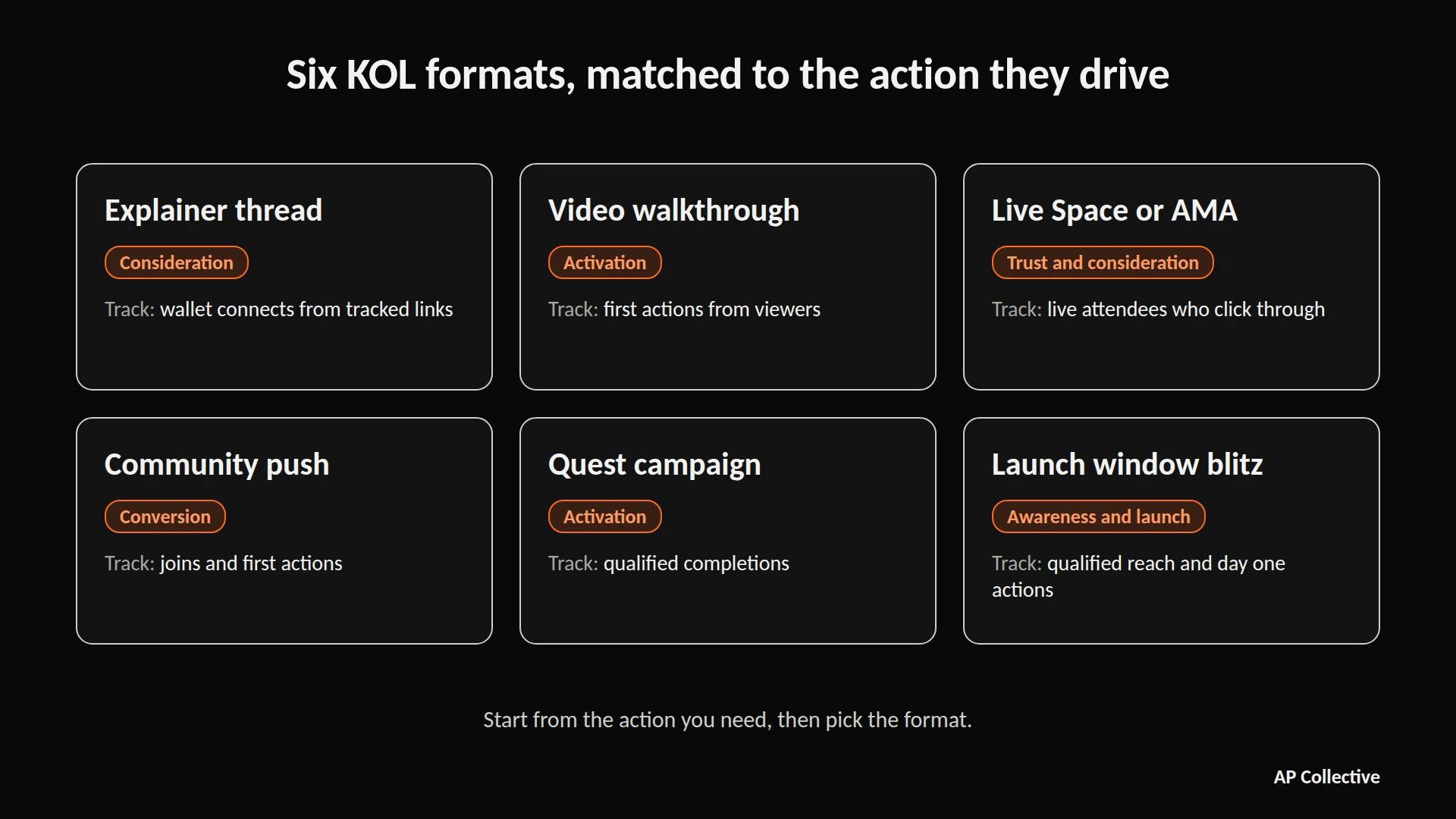
Read the grid by starting at the action, not the format. If you need first actions, look at video walkthroughs and quests. If you need trust before a launch, look at Spaces and threads.
Most campaigns mix two or three formats. The mistake is mixing them without knowing which one is supposed to move which number. We use the grid to give each format one job.
Explainer threads drive users by showing a real task from start to finish in 5 to 10 posts, so the reader leaves knowing what the product does and how to try it. A mid tier crypto KOL with 50,000 to 200,000 X followers can drive 100 to 500 wallet connections per campaign, per Track360’s KOL benchmarks. Treat that as a vendor estimate, not a promise.
The strongest threads share three traits:
Threads are cheap and quick, which makes them the best format to test. Run three creators with the same brief and compare wallet connects, not likes. Our guide to average CPMs of crypto KOLs covers what each tier typically costs.
If your team is planning a crypto launch, AP Collective can map the strategy, channels and creator formats before budget gets spent on disconnected campaigns. See how token launch marketing works, or talk to the team.
Video walkthroughs drive users by letting the viewer watch someone complete the product flow, which removes the fear of getting it wrong. Pricing ranges from about $500 for a single X thread to $10,000 to $50,000 for a YouTube deep dive from a top tier creator, according to the same Track360 guide, so video is the format to use when the action is complex.
Use video for products where the first step is the hard step: a new wallet, a bridge, a self custody setup, a trading interface. The creator shows each screen and says out loud what is happening, which is exactly what a hesitant new user needs.
Video also lasts. A thread peaks in a day, while a good walkthrough keeps sending viewers for months through search. That longer tail is part of its value and is why it deserves a higher fee.
Two cautions apply. Production is slower, so brief early and approve scripts for accuracy. And claims in video are more memorable, so set clear rules on what the creator may promise.
Live Spaces and AMAs drive users by building trust before the ask: people who hear your team answer hard questions in real time are more willing to try the product afterwards. They suit launches, controversial features and products where trust is the main barrier.
The format works best when you treat the live session as a source of content, not the whole campaign. Record it and cut clips. Post the three best answers as short threads. Pin the recording where new users will find it.
Attribution is the weak point. Live attendance is hard to track, and many listeners convert hours later. Plan for it: give every Space a unique link and a unique code, and watch first actions in the 48 hours that follow.
We would use Spaces for consideration, not for volume. They rarely drive the biggest spike. They reduce the objections that block everything else.
Community pushes drive users when a trusted creator recommends your product inside the Telegram or Discord groups where their followers already ask for advice. Intent is high because the creator’s members are already in a buying conversation.
Good pushes are specific. The creator answers a real question, such as which wallet to use for a given chain, and explains why. A pasted ad in a group gets muted or banned.
There are two limits. Many groups ban promotion outright, so the creator needs the admins’ agreement first. And closed groups are hard to measure, so use group specific links and track joins and first actions.
Pair community pushes with your own community work, so the users who arrive find a place to ask questions. See our community growth service for how we connect creator traffic to community retention.
Quest campaigns work with KOLs by pairing a creator’s reach with a task and a reward, so the audience is asked to do something specific, not just read a post. They are the most direct way to drive first actions, and the easiest to farm.
The risk is well documented. An academic study of nine major airdrops found that up to 66% of tokens were rapidly sold, often in the first transaction after claiming, according to the paper on arXiv. People who arrive for a reward tend to leave with it.
Design quests to attract people who will stay:
Running creator campaigns for a launch? AP Collective’s influencer marketing team briefs and reports on creators by what users do after the click. Ask for a scoped quote.
Performance deals beat flat fees when you can track the action you want to pay for, because they shift risk to the creator and align incentives. Track360 recommends structuring KOL deals with components such as cost per action on wallet connections or revenue share on volume, to avoid paying for impressions without conversions.
Deal Structure | How It Works | Best For | Main Risk |
Flat Fee | Fixed price per deliverable | Awareness and launches | Paying for reach that never converts |
Cost per Action | Payment per wallet, signup or first action | Conversion led campaigns | Creators avoid it if tracking is weak |
Revenue Share | Share of volume or revenue from referred users | Exchanges and trading products | Slow payout and attribution disputes |
Hybrid | Smaller flat fee plus a performance bonus | Most campaigns | Bonus triggers need exact definitions |
Hybrid deals are the version we reach for most. A flat fee covers the creator’s time and a bonus rewards results. Define the bonus trigger exactly, using one qualifying action and a fixed window.
Performance deals only work if tracking is solid. If you cannot tie users to a creator, pay a flat fee for reach and measure the campaign another way. Our guide to crypto influencer marketing pricing covers deal structures in more detail.
A launch window blitz works by coordinating many creators to post inside a short window around a launch, so the market sees one story from many voices at once. It is the format for awareness and day one momentum, and the hardest to run well.
Our Pudgy Penguins TGE coordinated 700+ KOLs and saw $2.54B in day one trading volume, as laid out in the Pudgy Penguins case study. On the MEXC campaign, 380+ creators produced 2.6M+ KOL impressions, as shown in the MEXC case study.
A blitz needs four things in place before the first post:
Day one volume shows reach and momentum. It does not show whether the community stays. Read day 30 and day 90 before you call a blitz a success, and see our TGE marketing strategy guide for the full launch sequence.
Brief creators for actions by telling them the single action you want, who they are speaking to, the one claim they can make, and what they must not say. A brief that only lists talking points gets posts that read like ads.
Seven items belong in every brief:
Rules for promoting crypto differ by market, and regulators treat creator posts as financial promotion in many places. Have counsel review the brief for each region before it goes out.
Our creator campaign playbook covers the full campaign process, from selection to reporting.
Track users from a KOL campaign with four methods used together: unique tracked links, promo or referral codes, wallet level attribution and a post signup survey. No single method catches everything.
Method | What It Catches | Blind Spot |
Unique tracked links | Clicks and wallet connects from each creator | Users who return later by search or direct visit |
Promo or referral codes | Users who enter the code | Users who forget or never see it |
Wallet level attribution | First onchain actions by source | Needs setup and clean data |
Post signup survey | Self reported source | Recall bias and low response |
The blind spots are the point. As noted earlier, last click analytics often credit organic or direct for conversions a KOL started. A survey that asks where a user first heard of you catches part of that gap. We cover the full setup in a separate attribution guide.
Need coverage and community moving together around your launch? AP Collective runs community growth and user acquisition as one system, with named deliverables on every line. Start with a scoping call.
Spot fake reach by checking audience overlap, comment quality, follower growth patterns and past campaign results, then running a small paid test before you sign a larger deal. Because 80% of untracked flat fee budget can vanish, as the Track360 guide reports, vetting is cheap by comparison.
Five checks catch most problems:
Follower count tells you little. A creator with 60,000 engaged followers who ask for recommendations often drives more users than one with 600,000 passive ones.
A crypto KOL campaign can cost from about $500 for a single X thread to $50,000 or more for a top tier creator or a whale account campaign, according to Track360 and HypeLab. The wide range reflects audience size, format and rights.
Two things sit on top of the fee: creator costs paid on your behalf and the agency fee for running the campaign. Keep them on separate lines so you can see what each part buys. Our guides to average CPMs of crypto KOLs and crypto KOLs versus paid ads cover rate benchmarks and how to compare channels.
Budget for the test before the scale. Start with three creators and one format, learn which one sends users who act, then put the larger budget behind it. Cost per qualified action is the number that matters, not cost per post.
Ask these eight questions before you sign, and treat vague answers as answers.
An agency that leads with its follower totals is selling the number that hides the problem.
AP Collective runs KOL campaigns by matching each format to the user action it should drive, then briefing, tracking and reporting on that action. We have run 700+ KOL activations across 150+ projects, work with a network of 5,000+ creators, and have delivered 600+ campaigns overall.
We have a clear limit. We will not buy followers, engagement or fake consensus, and we will tell you when a campaign needs a product fix before more creator spend. KOL work also suits teams with a live product and a defined first action better than concepts with no product yet.
For the full end to end process, see our crypto KOL marketing playbook.
AP Collective builds full stack crypto growth systems across strategy, creators, PR, community, content, partnerships and regional execution. See every service or book a strategy call.
What is crypto KOL marketing?
It is paid or incentivised promotion by creators with engaged crypto audiences on platforms such as X, YouTube and Telegram. The goal is users who act, not just reach.
Which KOL format drives the most users?
It depends on the action. Video walkthroughs and quests tend to drive first actions, threads drive consideration, and Spaces build trust. Test two formats before you scale one.
How much does a crypto KOL campaign cost?
From about $500 for a single thread to $50,000 or more for top creators. Cost per qualified action is a better measure than cost per post.
How many users does a KOL campaign drive?
One vendor estimates 100 to 500 wallet connections for a mid tier creator with 50,000 to 200,000 X followers. Results vary widely with format, product and audience.
Should I pay KOLs per action?
When you can track the action, yes, usually as a hybrid with a smaller flat fee. If you cannot tie users to a creator, pay a flat fee for reach.
How do I track KOL conversions?
Use unique links, codes, wallet level attribution and a post signup survey together. Expect last click analytics to undercredit KOLs.
How do I spot fake followers?
Check audience overlap, comment quality and follower growth spikes, ask for past campaign results, and run a small test post first.
Do KOLs need to disclose paid posts? Yes. Disclosure rules and financial promotion rules differ by market, so have counsel review each brief before it goes out.
How many KOLs should a launch use?
It depends on scale. Our Pudgy Penguins launch coordinated 700+ KOLs and MEXC used 380+ creators. For a first campaign, start with three creators to test formats.
Should I hire an agency for KOL marketing?
Hire one when you have a live product, a defined first action and a budget to test formats. Avoid anyone who reports followers or impressions as the result.
KOL campaigns drive users when the format fits the action, the brief names that action, and tracking proves it. Choose the format first, test cheaply, pay for actions where you can, and read retention before you scale.
Keep Reading
How to market a crypto wallet from first install to repeat use, with a five moment map, the metrics that matter and incentives that actually last.
How to compare founder personal branding agencies for crypto CEOs, using a four seat test for who writes, approves, distributes and responds to a crisis.
Crypto marketing attribution helps teams track the full journey from clicks and sign ups to deposits and first trades. Learn how to measure KOL performance, identify which campaigns bring real traders, and make smarter marketing budget decisions.
WHAT'S NEXT
Book a call with the team. No pitch deck required.