Top 10 DAO Marketing Agencies: Our Picks for Community Growth
Read article

Written by
Abhi
Founder & CEO
Published November 24, 2026
What you actually own after a crypto KOL campaign, what it should cost to reuse it, and how to put ad spend behind creator content without breaking a platform rule or a contract.
The creator fee is rarely the line that blows a crypto KOL budget. The rights are.
A project pays a creator for a thread or a 60-second video. The post works. The growth team wants to cut it into ads, run it from the creator's handle and stop the creator promoting a rival exchange for the next quarter. That is 3 new purchases, and most briefs never priced any of them. Industry benchmarks put whitelisting at an extra 20% to 50% of the base content fee for a defined licensing period, and that is before exclusivity enters the conversation.
This guide covers crypto influencer usage rights in 2026: how to buy, price and use reuse, whitelisting and exclusivity without overpaying.
Content rights are the permissions a creator grants a brand to use, edit, advertise or restrict their work beyond the original post. The base fee for a typical deal covers the agreed organic usage, such as publishing a Reel or TikTok on the creator's own account. Everything else needs to be named.
In crypto, 5 terms do most of the work:
The mistake is treating these as one thing. A KOL who happily lets you quote-post their thread may refuse to let you run a $30,000 ad budget through their handle. Both reactions are reasonable. They are different products.
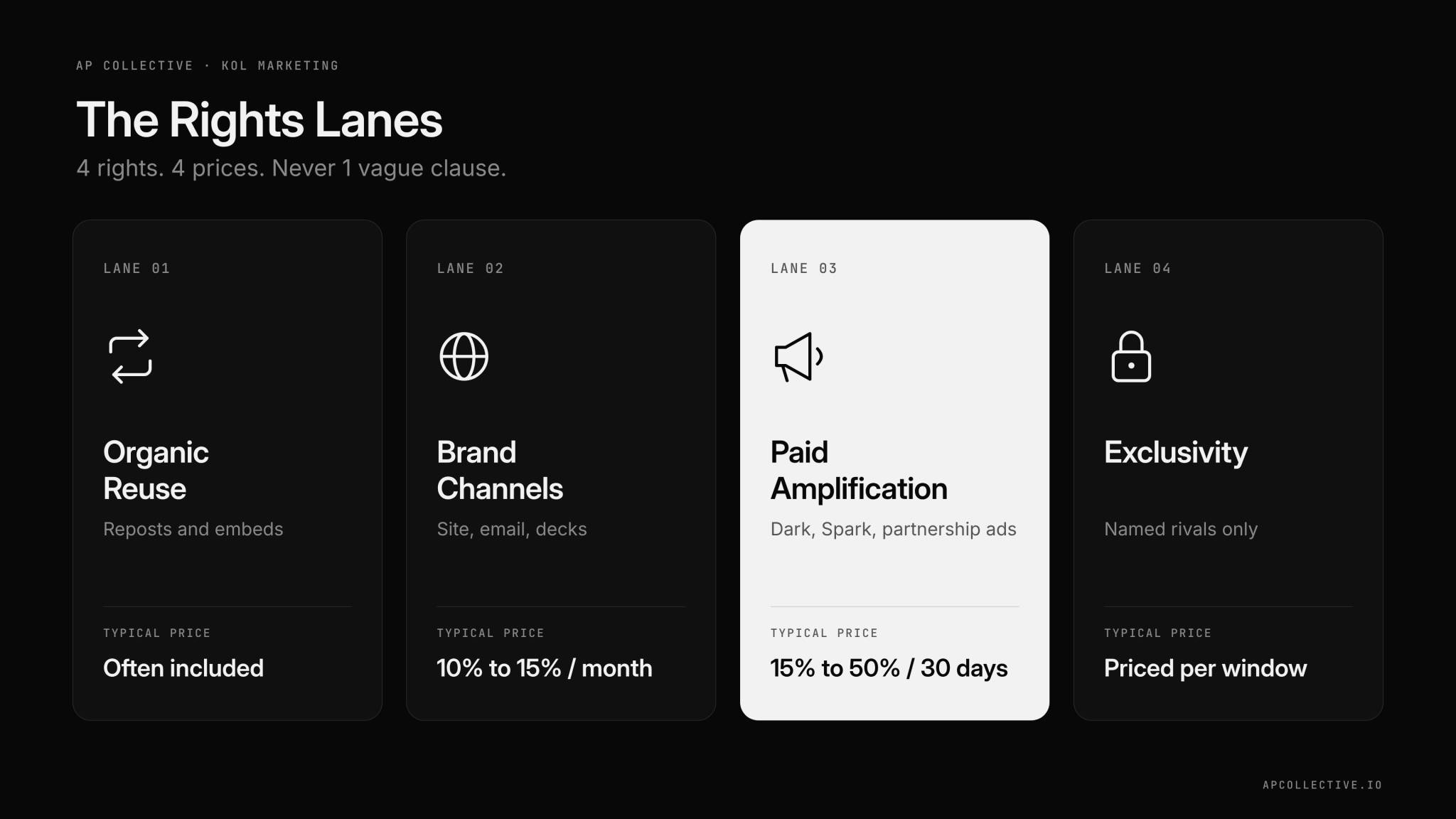
The Rights Lanes is a 4-lane model for buying creator rights. Each lane has its own price logic, its own clock and its own risk, and each one gets its own line in the contract.
Lane | What It Allows | Typical Price Signal |
|---|---|---|
1. Organic reuse | Reposts and embeds on brand accounts | Often included in the base fee |
2. Brand-channel reuse | Site, email, decks and owned media | 10% to 15% monthly after an included period |
3. Paid amplification | Dark ads, Spark Ads, partnership ads | 15% to 50% of base per 30 days |
4. Exclusivity | Creator avoids named rivals | Negotiated per category and window |
The benchmark sources differ on exact numbers. The Influencer Marketing Hub clause library suggests a monthly licensing fee of 10% to 15% of base once an included period ends, and 15% to 25% per 30 days for paid social usage.
The point of the Rights Lanes is not the precise figure. It is that a brief which names all 4 lanes gets 4 honest prices back, and a brief that says "full usage rights" gets one inflated number nobody can audit.
Organic reuse is the easiest right to secure and the one most often left out of the contract. Most creators are happy to give permission for brands to share their content organically for free, which is exactly why nobody writes it down.
Then the project gets acquired, rebrands or launches a token, and someone asks whether the 2024 creator threads can sit on the new site. Nobody knows.
What the Lane 1 clause should state:
One operator note: Telegram and Discord matter more in crypto than in consumer marketing. A creator's explainer pinned in a 40,000-member Telegram channel is reuse. Name the channel in the clause.
Brand-channel reuse means the content leaves social and lands in owned media: landing pages, onboarding emails, exchange listing posts, investor decks and event screens. It needs a clock (how long) and a map (where).
The market standard is a fixed term. If you need longer, the clause library suggests tying the fee to duration, for example 20% of base rate per month multiplied by the number of months. Perpetual use costs far more: one benchmark puts it at 6 to 12 times the monthly licensing fee, or a flat 200% to 300% of the creator's base rate.
That is why AP Collective rarely recommends perpetual all-media buyouts for crypto projects. The content ages faster than the licence. A video explaining your testnet is stale by mainnet. Paying 3 times the base fee to keep it forever is usually a waste.
The map matters as much as the clock:
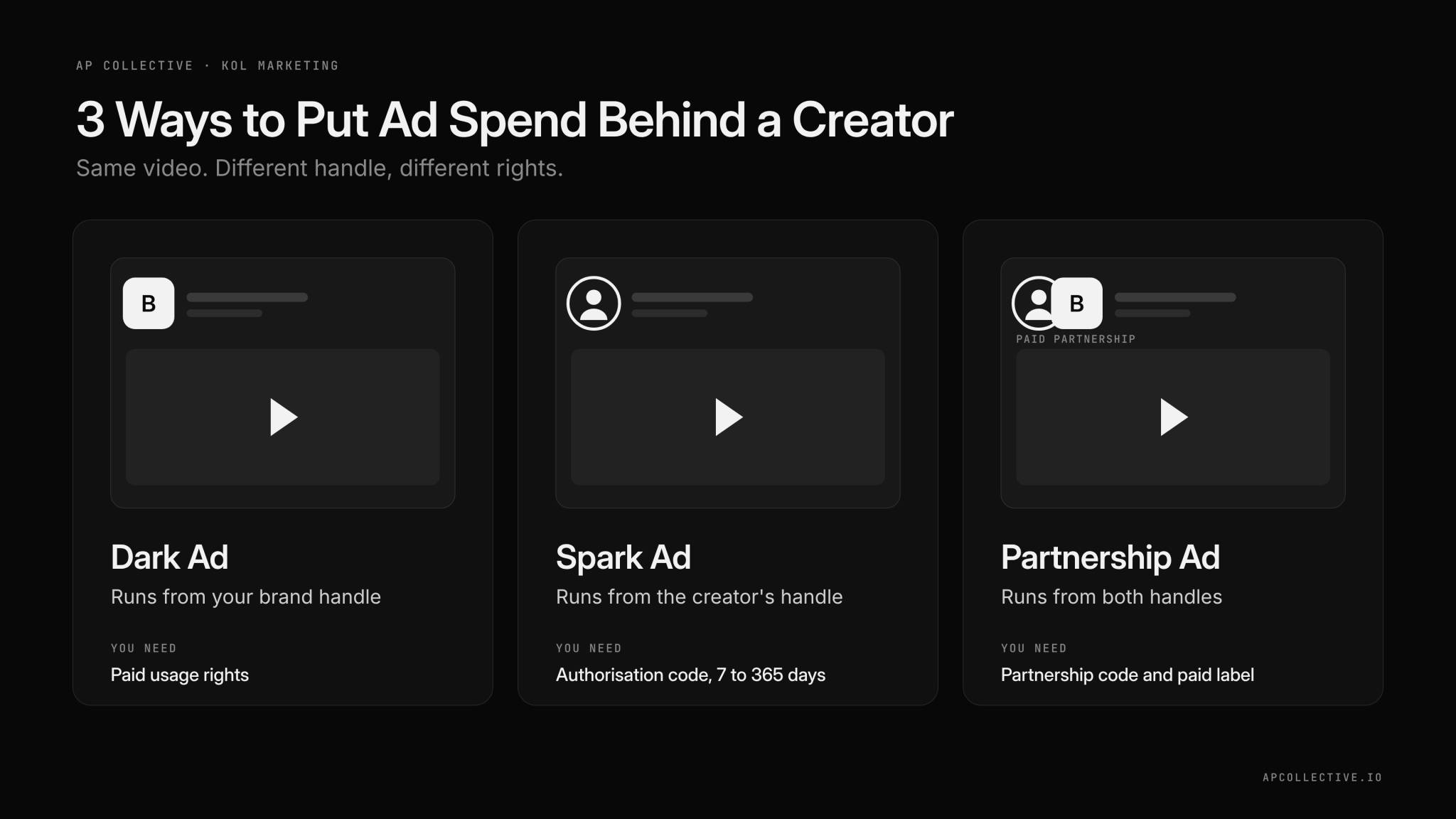
Paid amplification is spending ad budget behind creator content. It is the most valuable right and the most expensive one, and it splits into 3 formats that crypto teams constantly confuse.
The performance case is real. Meta's 2022 Marketing Science analysis of 15 split tests found partnership ads delivered 53% higher click-through rates and a 19% drop in cost per acquisition against standard brand ads.
Now the inconvenient part. A 2026 report covering $130M in ad spend found partnership ads beat licensed creator content from brand accounts on conversion, but carried a 19% higher CPM. The creator's face costs more to show. It only pays off if the click quality holds.
And a rule we give every client: set the Spark authorisation to cover the full flight plus a testing buffer. A 30-day code on a 30-day campaign expires before the winning variant scales.
Before buying Lane 3 rights, check that you can run the ad at all. Most consumer usage-rights guides skip this. In crypto it decides the deal.
The practical consequence: a token project without a licence may be able to pay a creator for an organic post but unable to boost that same post on Meta. Buying Lane 3 rights in that position is paying for a door that is locked.
We don't have good public data on how often crypto Spark and partnership ads get rejected at review. Anecdotally, rejections cluster around price language and yield claims. Strip those before submission, not after.
Exclusivity is the creator agreeing not to promote competitors for a period. It is the right crypto teams overbuy most often.
The creator's logic is fair: exclusivity costs them income, so they charge more to compensate for lost opportunities. The brand's logic is often lazy. "No other exchanges for 6 months" sounds safe and costs a fortune with a top-tier KOL who earns from 4 exchanges.
What good exclusivity looks like:
The clause library advice is the same: restrict exclusivity to named competitors and fixed campaign windows.
One more crypto-specific point. A KOL known for covering every L2 has value precisely because they compare chains. Buy their silence on rivals and you may buy away the credibility you hired them for.
Timing matters as much as scope. For Surf AI, AP Collective activated creators and ecosystem partners in waves timed to product releases. Exclusivity windows should follow the same calendar: cover each wave, not the whole quarter.
Creator rights pricing is mostly expressed as a percentage of the base content fee. Many creators charge 15% to 35% of their base rate per 30 days of usage, while others offer flat extension fees between $500 and $1,000.
Right | Common Benchmark | Source |
|---|---|---|
Paid social usage | 15% to 25% of base per 30 days | |
Whitelisting | 20% to 50% of base per licensing period | |
90-day exclusive whitelist | 2 to 3 times the post fee | |
Perpetual buyout | 200% to 300% of base | |
Raw footage | 20% to 30% surcharge |
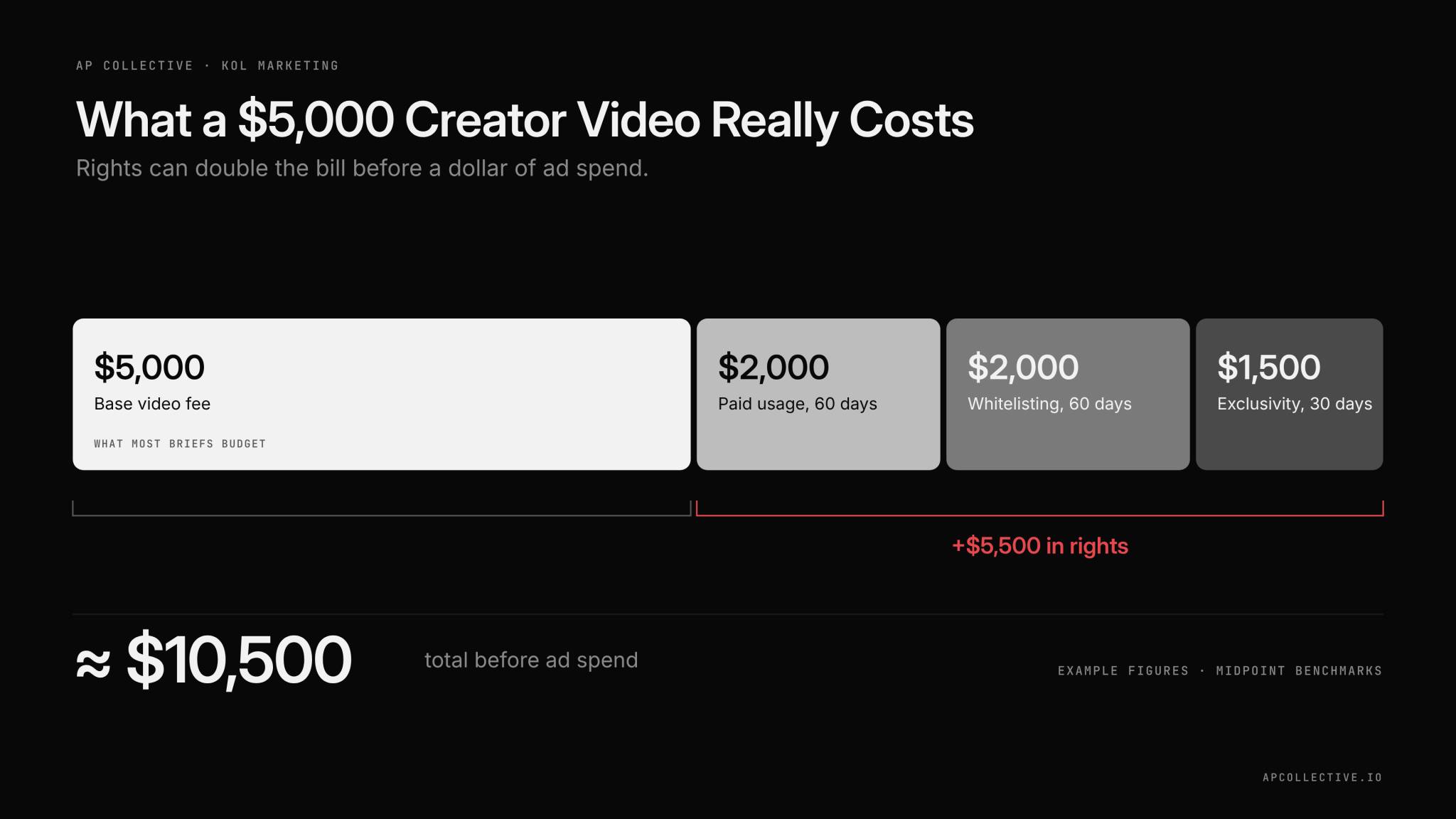
A worked example, using a $5,000 creator video:
An honest caveat: these benchmarks come mostly from consumer and ecommerce creator markets. Crypto KOL rates vary more, and top-tier crypto creators often price ads through their handle well above these ranges. Use the percentages as an opening frame, not a ceiling.
For how base rates are set in the first place, read our guide to crypto influencer marketing pricing, platforms and campaign structures and our breakdown of average crypto KOL CPMs.
If you'd rather not negotiate 4 lanes across 40 creators yourself, AP Collective's influencer marketing team scopes rights per creator before the first brief goes out.
Every reuse of creator content in an ad or on a brand channel is still an endorsement, and the disclosure has to come with it.
The rules are clear on the basics:
That last point is the one crypto teams miss. When you whitelist a creator's post into an EU campaign, the compliance burden is yours.
Practical rules for reused content:
This guide is educational and is not legal advice. Get your own counsel for contracts and financial promotion questions.
The common advice is to secure usage rights upfront for everything, because they cost less before the content proves itself. We disagree for most crypto campaigns.
Scale makes the point. AP Collective coordinated 700+ creators for a single token launch, the Pudgy Penguins TGE. Nobody boosts 700 posts. In any large creator wave, a handful of posts carries the results, and that handful is where paid rights belong. Buying Lane 3 on everything means paying for licences you will never use.
The better structure:
This keeps the creator protected, because the price is fixed before the content performs. And it keeps your budget tied to proof. Even the creator-side benchmarks agree that if a creator wants 40% or more of their base rate for monthly usage, the math won't usually work in the brand's favour.
The trade-off is real. Some top KOLs won't sign an option and want the full licence fee upfront. For those creators, decide before the brief whether you'd actually boost their content. If the answer is no, don't buy Lane 3.
When the winners are clear, our user acquisition team can turn those posts into a paid programme with proper attribution.
Use this before any creator contract goes out. Each question maps to the Rights Lanes.
Organic reuse
Brand-channel reuse
Paid amplification
Exclusivity
Everything else
That last question tells you more about a creator than their media kit does.
|
Paid amplification only earns its rights fee if the creator-led ad beats your brand creative on cost per real user. Measure that, not likes.
|
Run a clean split: same objective, budget and audience, then compare cost per acquisition over the same window. If the creator ad doesn't beat the brand ad on cost per funded account, don't renew the licence.
Not every project should measure the same thing. An exchange cares about deposits. A DeFi protocol cares about TVL from new wallets. A game cares about day-7 players. Agree the metric before the rights fee, not after.
For the wider debate on creators versus ads, see crypto KOLs vs paid ads.
AP Collective is a digital marketing agency working across crypto, AI and iGaming. Its creator work includes token launch amplification for Pudgy Penguins, KOL coordination for NEAR Protocol that drove 9.2M+ KOL impressions and 427K engagements, and the community and creator distribution that took Anichess to the top of its category for mindshare. Rights are scoped in the brief, not argued about after a post goes viral.
How that works in practice:
The limitation, stated plainly: this approach adds a few days of negotiation upfront. Teams that need 50 creators live in 72 hours will find it slower than a bulk buy.
See the results in our case studies, or talk to the team about scoping rights for your next creator campaign.
Does paying a crypto influencer mean I own the content?
No. A standard fee buys the creator posting on their own account. Reuse, ads and exclusivity are separate rights and need to be written into the contract.
What is the difference between usage rights and whitelisting?
Usage rights let you use the content in your own channels and ads. Whitelisting lets you run ads from the creator's own handle, which usually costs more.
How much do usage rights cost for crypto creators?
Benchmarks put paid usage at 15% to 25% of the base fee per 30 days, and whitelisting at 20% to 50%. Top-tier crypto KOLs often price above these ranges.
Can I run Spark Ads for a token project?
Only if your project meets TikTok's financial services ad policies in each target market. Check eligibility before you buy the rights.
Do I need Meta's permission to boost a crypto creator post?
Yes, if the ad promotes an exchange, trading platform, lending product or wallet with trading features. Meta requires written permission and a recognised licence.
How long should a Spark Ads authorisation be?
Long enough to cover the full campaign plus a testing buffer. TikTok offers 7, 30, 60 or 365 days.
Is exclusivity worth paying for?
Sometimes, if it's limited to 3 to 5 named rivals for a short window. Category-wide exclusivity is rarely worth the price.
Do reused creator ads still need a disclosure?
Yes. The paid-partnership label and any spoken or on-screen disclosure should stay visible in every version of the content.
Who is responsible for MiCA compliance in an influencer post?
The issuer or offeror of the crypto-asset carries the legal duty for marketing communications under MiCA, not the individual influencer.
Should I buy perpetual rights to creator content?
Rarely. Perpetual buyouts can cost 200% to 300% of the base fee, and most crypto content goes stale within months.
Creator rights are where crypto KOL budgets quietly double. Price them in lanes, buy options instead of blanket licences, check ad eligibility first and keep the disclosure attached to every reuse.
About the author: Abhi is the Founder & CEO of AP Collective. Serial entrepreneur with 5+ years in blockchain, digital marketing and advisory. More from Abhi.
Keep Reading
WHAT'S NEXT
Book a call with the team. No pitch deck required.